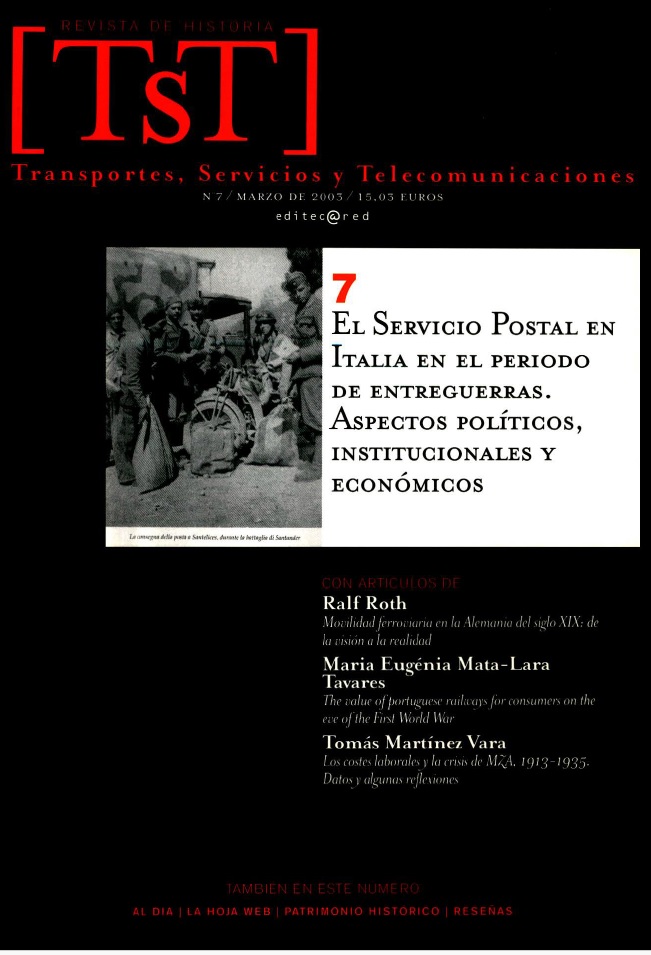
TsT7. 2004.
Dossier
♦ Andrea Giuntini
The Postal Service in Italy During the Interwar Period: Political, Institutional, and Economic Aspects
Abstract:
This article analyzes the evolution of the Italian postal and telegraph service during the interwar period. Starting from an incipient process of modernization, Italy’s involvement in World War I led to a dramatic increase in mail demand, which caused serious disruptions in the short term but ultimately resulted in significant changes to the existing postal structure. The text examines how each of these changes took shape, distinguishing chronologically between the war, the postwar period, and the establishment of the Fascist state.
♦ Ralph Roth
Railway Mobility in 19th-Century Germany: From Vision to Reality
Abstract:
The first vision of a rail-based transportation network in Germany dates back to the 1810s. Since then, a debate about the future of the railroad has been unfolding, one that intensified with advances in railway technology in England. This debate, documented in hundreds of memoranda (Denkschriften), spread the idea of railroads and outlined a specific vision of their social, political, and cultural implications for society. This literature was instrumental in a movement that gave rise to numerous committees, which in turn led to the formation of many private railroad companies. Many of the main lines of the German railway network were built by these companies in the 1840s, 1850s, and 1860s. Just as railway enthusiasts had predicted, this network had far-reaching consequences for German society. More than any other advancement, railroads increased the mobility of the poor. For social and economic reasons, this was a development of strategic importance. In fact, low fares led to a massive migration of the lower classes. Without this population movement, the great modernization processes of the nineteenth century would not have occurred; industrialization and urbanization would not have taken place.
♦ Eugénia Mata and Lara Tavares
The Value of Portuguese Railways for Consumers on the Eve of World War I
Abstract:
This article discusses methodological approaches to assessing the economic impact of railroads. Traditionally, economic historians have relied on social savings to evaluate the benefits of railroads. This concept, as it is typically defined in the relevant literature, imposes several strong assumptions. In the authors’ view, these assumptions are too rigid, as social savings cannot be considered a precise measure of the impact of railways. For this reason, an alternative approach to measuring this impact is proposed. Instead of using a counterfactual analysis, the article examines the increase in welfare brought about by railways—that is, changes in consumer surplus. To estimate consumer surplus in 1914, demand functions had to be calculated first, which also made it possible to calculate the price elasticities of passenger and freight transportation. The results show that price elasticities were low, while consumer surplus was significant, highlighting the effects of the government’s economic policy on the construction of transportation infrastructure and the setting of low fares for users.
♦ Tomás Martínez Vara
Labor Costs and the MZA Crisis, 1913–1935: Data and Some Reflections
Abstract:
This paper examines the evolution of labor costs at MZA between 1913 and 1935, a period coinciding with the so-called “Railroad Problem.” Much of the article is devoted to presenting and critically analyzing the numerous and diverse sources used, most of which are corporate in nature and almost always unknown to historians. The information they provide is as rich as it is varied: wages and non-wage benefits, working conditions, business strategies, and employment. The assumptions and methodology used to construct the time series included in the extensive appendix are clearly explained. These calculations are of great interest not only for understanding the impact of rising labor costs on the company’s crisis but also as a resource for future studies of the history of railroad labor in general.
Historical Heritage
♦ Manuel Carnicero Arribas
The Archives of the Community of Madrid
Abstract:
The state of business archives in the Community of Madrid is characterized by the dispersion of their sources and studies, as well as by a lack of professional contact among archivists themselves, coupled with the absence of national, regional, and corporate policies that establish guidelines for business archives.
The article begins with a brief overview of the Community of Madrid, covering both its business landscape and regional legislation regarding business archives. The archival study proper begins with a comprehensive overview of archives in the world of work: trade unions and associations; the regional public business sector, at both the local and regional levels; the national public business sector, including the major public enterprises; and the private business sector. It has been observed that professionals exist in large state-owned enterprises—though not in all of them—and that there is a general absence of such professionals in the private sector, where archives are managed by service companies.
The purpose of this article is to document the existence of numerous archives that, for various reasons, have remained marginalized and forgotten. It is intended as a first step not only toward compiling and publicizing the existing documentary collections but also toward bringing to light the remaining archives and archivists—who undoubtedly exist within the Community—for the sake of Madrid’s historical heritage.
Reviews
♦ Tomás Martínez Vara
Various Authors, The World of Work at Renfe: An Oral History of the Infrastructure
♦ Jesús Mirás Araujo
Mª J. Freire Seoane and F. González Laxe, The Economics of Maritime Transport
♦ Drew Whitelegg
Gregory J. Downey,, Telegraph Messenger Boys: Labor, Technology, and Geography, 1850–1950
♦ Sonia Montilla Pérez
Various Authors, Tourism and the New Society
♦ Javier Vidal Olivares
Martin Staniland, Government Birds: Air Transport and the State in Western Europe