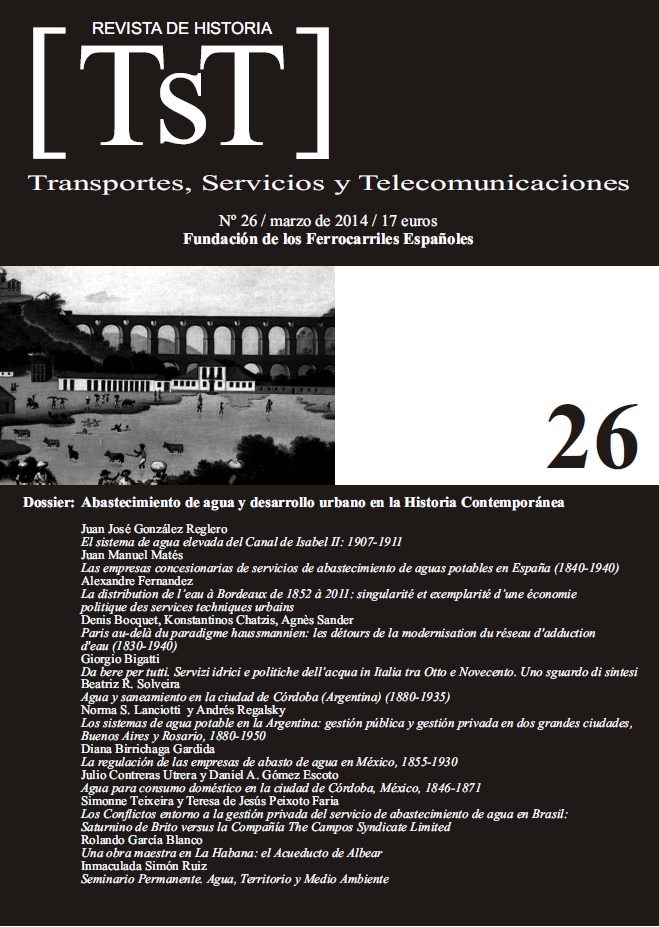
TsT26. 2014.
Dossier
Water Supply and Urban Development in Contemporary History.
Juan Manuel Matés (Editor)
♦ Juan José González Reglero
The Canal de Isabel II Elevated Water System: 1907–1911
Abstract:
This article details the construction of the Canal de Isabel II’s elevated water distribution system, which took place between 1907 and 1911. It was built in competition with the city council’s concession granted to Hidráulica Santillana, which at that time was carrying out work to supply and distribute water to the highest-elevation areas of the capital. Upon completion, the Canal was able to supply water, with guaranteed pressure, to the entire expanse of the Plan de Castro expansion: the neighborhoods of Salamanca, Chamberí, Cuatro Caminos, Prosperidad, Guindalera, etc. The article also discusses the water conveyance system from the Fuente de la Reina, the precursor to this type of system for supplying water to Madrid.
♦ Juan Manuel Matés
Drinking Water Supply Concession Companies in Spain (1840–1940)
Abstract:
This paper aims to describe the evolution of companies dedicated to drinking water supply in Spanish cities. This process of establishment began during the Second Industrial Revolution and continued, with some fluctuations, until 1936. The first part examines the role these companies played within the Spanish business context. The second part addresses certain aspects related to their typology—with a clear numerical predominance of small family-owned businesses—and their stability in the industry.
♦ Alexandre Fernandez
Water Distribution in Bordeaux from 1852 to 2011: The Uniqueness and Exemplary Nature of a Political Economy of Urban Technical Services
Abstract:
When the Bordeaux City Council took over water supply in 1852, the city became one of the best-served in France. However, this progress gradually eroded, and, above all, the sanitation system lacked even the most basic infrastructure to meet the needs of a population of 300,000. In 1949, the Bordeaux City Council commissioned Lyonnaise des Eaux to supply water to the residents of the metropolitan area and to provide sanitation services for the city. Since 1967, the supra-municipal entity—the Bordeaux Urban Community (whether governed by the right or the left)—has renewed the public service delegation contracts (concessions and leases) in favor of the private company Lyonnaise des Eaux. The company managed the significant growth in consumption that characterized the second half of the century and, initially, handled the environmental challenge very well. However, since the beginning of the 21st century, it has faced the challenge of “new citizenship.” In April 2011, the Communauté urbaine de Bordeaux voted to return to direct management by 2018. This article aims not only to highlight the unique aspects of this history of water supply in a major French city but also to analyze the extent to which this case serves as a model for a general history of the political economy of urban technical services in France.
♦ Denis Bocquet, Konstantinos Chatzis, Agnès Sander
Paris Beyond the Haussmannian Paradigm: The Twists and Turns of the Modernization of the Water Supply Network (1830–1940)
Abstract:
For a long time, the century-long process in Paris of universalizing access to the water supply network has been interpreted solely through the lens of the paradigm of gradual integration into a unified system and the step-by-step spread of progress among the population. And indeed, the Parisian example has provided fertile ground for such interpretations. However, with the recent diversification of research questions concerning technical networks and the drivers of urban modernization, attention is now increasingly turning to what were previously considered minor stages or secondary aspects of an inevitable and linear process. The purpose of this article is, drawing on these recent research trends, to examine the Parisian case in a new light. This does not, of course, mean completely calling into question the foundations of what we know about water in Paris, but rather highlighting how certain processes were more complex and nuanced than is often assumed: universal access, the role of public institutions, spatial diffusion, and political choices.
♦ Giorgio Bigatti
Water for Everyone: Water Services and Water Policy in Italy from the 19th to the 20th Century. An Overview
Abstract:
This paper focuses on the democratization of water consumption in Italy, providing a brief overview of the key stages in the development of the “hygienic city” between the 19th and 20th centuries and the role of the actors involved in creating one of the key infrastructures of the networked city: municipalities, companies, and engineers.
♦ Beatriz R. Solveira
Water and Sanitation in the City of Córdoba (Argentina) (1880–1935)
Abstract:
The objective of this study is to examine the difficulties faced by the city of Córdoba in its attempt to establish running water and sanitation services—sewers and drainage systems—and the controversies surrounding the management models applied to these services, from the inauguration of the running water system until the mid-1930s, a period during which management was, first and successively, the responsibility of a private company, the provincial government, and the municipality, and then passed to agencies created for that purpose by the federal government. The aim of this analysis is to demonstrate that, in the case of Córdoba, the private sector showed little interest in managing these services and that its only effective intervention, prior to that of the public sector, failed, leaving the field open for action by municipal, provincial, and national authorities—a process marked by the inefficiency of the former, the failure of the latter, and the satisfactory management of the latter, which had adequate technical, administrative, and financial resources and made the city’s sanitation possible.
♦ Norma S. Lanciotti and Andrés Regalsky
Drinking Water Systems in Argentina: Public and Private Management in Two Major Cities, Buenos Aires and Rosario, 1880–1950
Abstract:
This article traces the history of public water systems in Argentina from the late 19th century until their nationalization in the post-World War II period. To compare public and private management models, the article analyzes the investment strategies and financing approaches implemented by the General Directorate of Sanitation Works (later reorganized as the public enterprise Obras Sanitarias de la Nación) in the city of Buenos Aires, and by the British companies The Rosario Waterworks Co. and The Rosario Drainage Co. in the city of Rosario. The study also compares the evolution of costs and returns, as well as outcomes in terms of service quality and coverage. It is observed that development followed a similar trajectory as long as access to the international financial market was maintained. Following the crisis of 1930, while the service managed by OSN continued to expand in Buenos Aires, the cessation of British investment led to reduced coverage
♦ Diana Birrichaga Gardida
The Regulation of Water Supply Companies in Mexico, 1855–1930
Abstract:
This paper analyzes the institutional framework in Mexico that influenced the creation of the first drinking water companies. Beginning in the 1840s, Mexican leaders promoted various economic measures to establish a modern industry, particularly in textiles and mining; however, the political and economic instability Mexico experienced delayed the modernization project. It was not until the administration of Porfirio Díaz (1876–1910) that a policy of industrial promotion was consolidated; during these years, an institutional framework emerged that gave rise to a close relationship between the state and private companies. President Porfirio Díaz encouraged the establishment of new industries through a system of concessions and tariff support. Favorable legislation attracted investment in sectors such as mining, railroads, and public utilities.
♦ Julio Contreras Utrera and Daniel A. Gómez Escoto
Water for Domestic Consumption in the City of Córdoba, Mexico, 1846–1871
Abstract:
Currently, millions of people are paying close attention to weather forecasts. As winter draws to a close, the public becomes increasingly interested in learning—through any media outlet—whether the hot and rainy seasons will be prolonged, in order to prevent droughts or floods. Both situations are also a concern for municipal, state, federal, and even international authorities. The issue of water is also of interest to scholars who, from various perspectives, contribute to solving the problems arising from water consumption. Most studies on water focus on the late colonial period, the late 19th century, and the early 20th century. There is a lack of research addressing this issue in the first half of the 19th century. In this regard, this paper analyzes the water supply in the city of Córdoba, Veracruz. The research begins with a description of the city to provide context for the area under study.
♦ Simonne Teixeira and Teresa de Jesús Peixoto Faria
Conflicts Surrounding the Private Management of Water Supply Services in Brazil: Saturnino de Brito versus The Campos Syndicate Limited
Abstract:
This article aims to contribute to our understanding of the processes involved in the installation and management of the first drinking water supply services in Brazil. For this case study, we analyze the role of the British company The Campos Syndicate Limited during the installation of the water supply network and the sewage and stormwater drainage systems in the city of Campos dos Goytacazes, in the state of Rio de Janeiro. Conceived as part of an institutional plan to combat the epidemics and diseases ravaging Brazilian cities, the installation of these services stood out as a major urban development initiative, grounded in the ideals of modernity. However, sanitary engineer Saturnino de Brito believed that public health interests were not compatible with the private management of sanitation services, and he became a prominent critic of the English company. We seek to uncover the conflicts and problems related to the installation and management of the company’s water supply and sanitation services, aiming to identify—through the various discourses of public authorities, specialists, and the general population—the relationship between water quality and health.
♦ Rolando García Blanco
A Masterpiece in Havana: The Albear Aqueduct
Abstract:
This work addresses the issue of water supply since the permanent settlement of San Cristóbal de la Habana in 1519. It describes how, until the late 19th century, the city depended on water supplied from the Almendares River via the Zanja Real (1592) and the Fernando VII Aqueduct (1835)—sources that, by the second half of the 19th century, could no longer guarantee a sufficient supply for 100,000 inhabitants. The article provides an assessment of the project carried out by Francisco de Albear y Fernández de Lara, as well as a historical overview of the construction process, from the start of work in 1858 to its completion as the Albear Aqueduct in 1893, and offers concluding remarks on the merits of this remarkable engineering feat.
♦ Inmaculada Simón Ruiz
Permanent Seminar: Water, Land, and the Environment
Abstract:
The evolution of mining regions across Spain reveals a series of constants, among which the presence of the railroad stands out for its importance as a unifying force. From the moment these regions began to develop, the railroad’s presence spurred dynamism and connectivity, while also helping to integrate the territory by linking the various productive agents involved in the industrialization process. In the Guadiato coalfield, north of the Sierra Morena in Córdoba, the presence of entities such as MZA, Ferrocarriles Andaluces, and the Sociedad Minero Metalúrgica de Peñarroya shaped the railway landscape we know today. Based on their presence and the productive orientation of these railroads, the architecture of the stations that dot this landscape shares certain common elements that, at the same time, are unique to each corporation. Highlighting the importance of these railroads, examining their key architectural features—with special emphasis on the stations—and recognizing them as part of the Guadiato Valley’s industrial landscape is essential to promoting their understanding, conservation, and wider awareness.
Reviews
♦ Carmen Herráiz
Jesús Raúl Navarro García and Jorge Regalado Santillán, The Water Debate in Jalisco and Andalusia
♦ Leonardo Caruana de las Cagigas
Jesús Raúl Navarro García, Jorge Regalado Santillán, and Alejandro Tortolero, Water, Territory, and the Environment: Public Policy and Citizen Participation
♦ Juan Manuel Matés Barco
Manuel Guárdia, The Water Revolution in Barcelona: From Preindustrial City to Modern Metropolis, 1867–1967
♦ Inmaculada Simón Ruiz
Jesús Raúl Navarro García, Studies on Water in Spain: Documentary and Bibliographic Resources
♦ Jesús Raúl Navarro García
Julio Contreras Utrera, Between Unsanitary Conditions and Hygiene: Water Supply in the Major Urban Centers of Chiapas, 1880–1942
♦ Mariano Castro Valdivia
Luis Castro Castro, Modernization and Social Conflict: The Expropriation of Irrigation Water from Peasants in the Quisma Valley (Pica Oasis) and the Government-Funded Water Supply to Iquique, 1880–1937
♦ Rosa Lidia Vuolo
Jesús Blanca Jiménez, María Luisa Torregrosa, and Luis Aboites Aguilar, Water in Mexico: Natural Watercourses and Channelization
♦ Gloria Paterna Sánchez
María Alicia de los Ángeles Guzmán Puente, Community Participation and Alternative Practices Toward Integrated Watershed Management: The Case of the Upper Central Region of Morelos
♦ Ricardo Serna Galindo
Rosalva Loreto López, Water, Skin, and the Body in the Everyday History of a Mexican City: Puebla, 16th–20th Centuries
♦ David Marrero Blanco
Rosalva Loreto López, Water, Urban Power, and Social Metabolism
♦ Julio Contreras Utrera
José Manuel Prieto, Vicente Abadín García: A Businessman from Viveiro in Havana, 1880–1942
♦ Begoña Blasco
Israel Sandré Osorio and Martín Sánchez, The Missing Link: Agreements, Conventions, Regulations, and Local Water Laws in Mexico (1593–1935)