Oct. 19, 2010.
Dossier
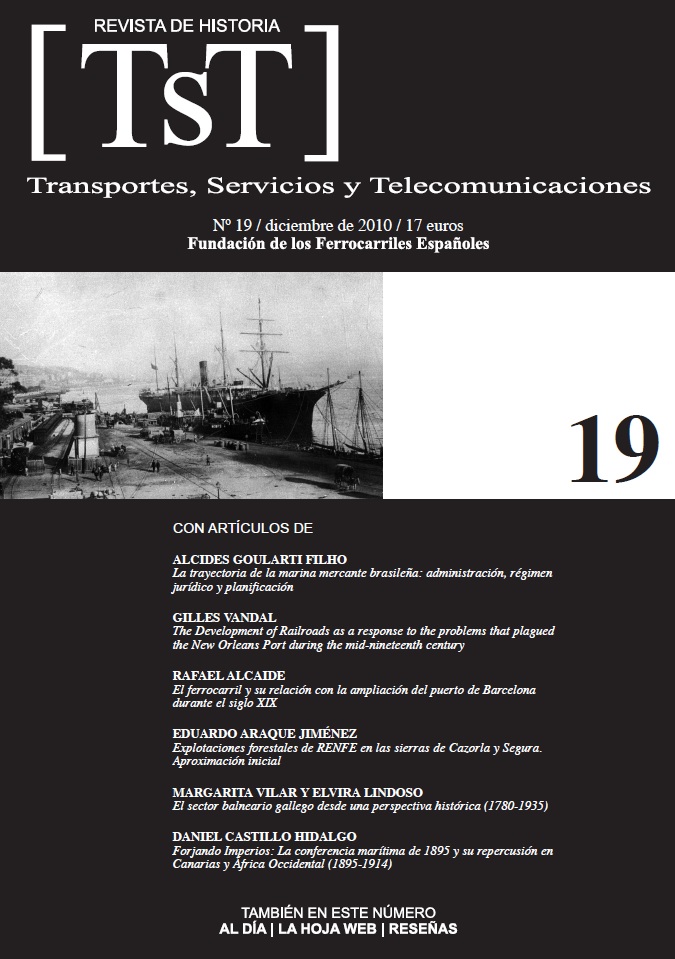
♦ Alcides Goularti Filho
The History of the Brazilian Merchant Marine: Administration, Legal Framework, and Planning
Abstract:
The objective of this article is to discuss the expansion, crisis, and partial dismantling of the Brazilian merchant marine, highlighting its legal, administrative, and planning frameworks throughout this history. The period analyzed spans from the formation of the Comissão da Marinha Mercante in 1941 to the end of President Fernando Henrique Cardoso’s administration in 2002. From this period, we will discuss the formation of the national economic system and the contradictory dynamics of the national merchant marine. The text is divided into three parts: 1) Expansion: centralization, planning, and nationalization, accompanied by the consolidation of the shipbuilding industry, highlighting the role of the Comissão da Marinha Mercante and the Superintendência Nacional de Marinha Mercante (SUNAMAM) in planning and financing national maritime transport;
2) Crisis: covers the 1980s, when SUNAMAM suffered severe political erosion and lost all its financing capacity; 3) Partial dismantling: the denationalization and privatization of national maritime transport, as well as the profound restructuring of the shipbuilding industry, with an emphasis on the creation of the National Waterway Transport Agency during the final years of President Fernando Henrique Cardoso’s administration.
♦ Giles Vandal
The Development of Railroads as a Response to the Problems that Plagued the New Orleans Port during the Mid-Nineteenth Century
Abstract:
From 1820 to 1860, New Orleans underwent constant expansion. By 1840, New Orleans ranked fourth among U.S. cities in terms of population size. But the expansion of trade passing through the Port of New Orleans was even greater. The value of trade in that city, which amounted to $16 million in 1820, had reached $324 million by 1860. Between 1820 and 1860, no other port in the world handled a greater variety of cargo. On the eve of the Civil War, some 1,500 ships entered the Port of New Orleans each year. By then, the volume and value of goods transiting through New Orleans were surpassed only by London, Liverpool, and New York. However, despite these successes, the Port of New Orleans faced stiff competition and ever-increasing challenges.
The success of the Port of New Orleans was based on its control of inland traffic and depended largely on a network of rivers that carried goods to the western port. Furthermore, in the 1850s, many other U.S. cities were investing in the development of rail lines to direct traffic toward their ports. In the mid-19th century, New Orleans authorities implemented various policies to adapt to a difficult situation and to cope with growing commercial competition. Among these measures, the development of a major railway network was paramount. This article examines how the development of railroads helped maintain New Orleans’ dominance in global trade during the second half of the 19th century.
♦ Rafael Alcaide
The Railroad and Its Relationship with the Expansion of the Port of Barcelona During the 19th Century
Abstract:
The relationship between Barcelona’s port infrastructure and the Catalan capital’s railway network began with the various projects carried out during the second half of the 19th century to expand the Port of Barcelona.
In some cases, these projects were part of the Expansion Plans for the city of Barcelona and were driven by the need to expand the city’s port facilities due to the constant growth of industrial concentration since the early decades of the 19th century. This industrial activity, with its demand for raw materials, led to a significant increase in port traffic, aided by the technical improvements that had begun to be introduced on ships, such as the implementation of the steam engine.
In this regard, the progressive expansion of the railway in the city and the need to build an internal rail network to serve the port and its docks—one that would be connected to the city’s various railway stations—led to the development of two railway projects, closely linked to the expansion of the Port of Barcelona.
♦ Eduardo Araque Jiménez
RENFE Forest Operations in the Cazorla and Segura Mountain Ranges. An Initial Overview
Abstract:
The international isolation to which Spain was subjected at the end of the Civil War forced the State to focus all its attention on the Segura and Cazorla mountain ranges, one of the main forest resources in the southern half of Spain, in order to obtain a significant portion of the timber needed for the reconstruction of the deteriorated railway network. Explotaciones Forestales, a division created within RENFE shortly after its establishment, was responsible for managing the forests and supplying processed timber between 1942 and 1988. The work carried out by this company, as well as its economic, social, and ecological consequences in one of the most economically depressed yet best-preserved areas of Andalusia, form the central focus of this article.
♦ Margarita Vilar and Elvira Lindoso
The Galician Spa Industry from a Historical Perspective (1780–1935)
Abstract:
The main objective of this study is to analyze the origins and historical evolution of Galician spas within the broader Spanish spa sector from the late 18th century through the Civil War, using new quantitative evidence. The analysis highlights how Galicia successfully leveraged its natural wealth of mineral-medicinal waters and maintained a dominant position in the spa sector during the period under study. The main driving factors behind this development include the institutional framework, the financial investment by local business leaders and prominent figures, and the dual nature of Galicia’s spa offerings, comprising two basic types of establishments: thermal resorts catering to an elite clientele and traditional, popular spas deeply rooted in the region.
♦ Daniel Castillo Hidalgo
Forging Empires: The 1895 Maritime Conference and Its Impact on the Canary Islands and West Africa (1895–1914)
Abstract:
Maritime conferences are a historical phenomenon that became widespread in the last third of the 19th century. Their guiding role in organizing maritime activity led to the establishment of Atlantic hierarchies, in which shipping companies would play a fundamental role. In the Canary Islands and West Africa, the conference agreement between Elder Dempster and Woermann Linie in 1895 led to a restructuring of port traffic, boosting activity in Canarian ports and placing them at the forefront of ports in the mid-Atlantic. The companies participating in this conference also enjoyed a comparative advantage over their competitors.
Historical Heritage
♦ Eduardo Romero de Oliveira
Railway Museums in the State of São Paulo (Brazil): Conservation Policies and the Current State of Brazilian Railway Heritage
Abstract:
This article presents three examples of industrial railway museums in the State of São Paulo (Brazil), their collections, and the preservation efforts undertaken in recent years. The following institutions have been the focus of our current research: the Paulista Railway Company Museum, the RFFSA/Bauru Documentation Center, and the Sorocaba Railway Museum. All these museums are located in former railway activity areas, facing various preservation challenges (regarding facilities, collections, and visitor access). Our objective is, on the one hand, to present the current state of the railway heritage that comprises these museums’ collections; on the other hand, to understand the nature of cultural policy initiatives in these cities and the characteristics of the museums established there. We conducted a historical study on the creation of the museums; we interviewed the heads of the institutions regarding the museums’ projects and objectives, exhibition proposals, and educational activities.
Reviews
♦ Carlos Álvarez Nogal
Pedro Tedde de Lorca (Editor), The Finances of Castile and the Spanish Monarchy (16th–17th Centuries). A Tribute to Felipe Ruiz Martín
♦ José Luis García Ruiz
Jèronia Pons Pons and María Ángeles Pons Brías (Editors), Historical Research on Spanish Insurance
♦ Hilario Casado Alonso
Stephan Epstein, Freedom and Growth. The Development of States and Markets in Europe, 1300–1750
♦ Andrés M. Regalsky
Jorge Schvarzer and Teresita Gómez, The First Great Argentine Enterprise: The Western Railway (1854–1862)
♦ Carlos Larrinaga
Alberte Martínez (Editor), Jesús Mirás and Elvira Lindoso, The Gas Industry in Galicia: From Gas Lighting to the 21st Century, 1850–2005
♦ Francisco Cuadros Trujillo
Carlos J. Pardo Abad, Tourism and Industrial Heritage
♦ Begoña Villanueva García
Robert Millward, Private and Public Enterprise in Europe: Energy, Telecommunications, and Transport, 1830–1990