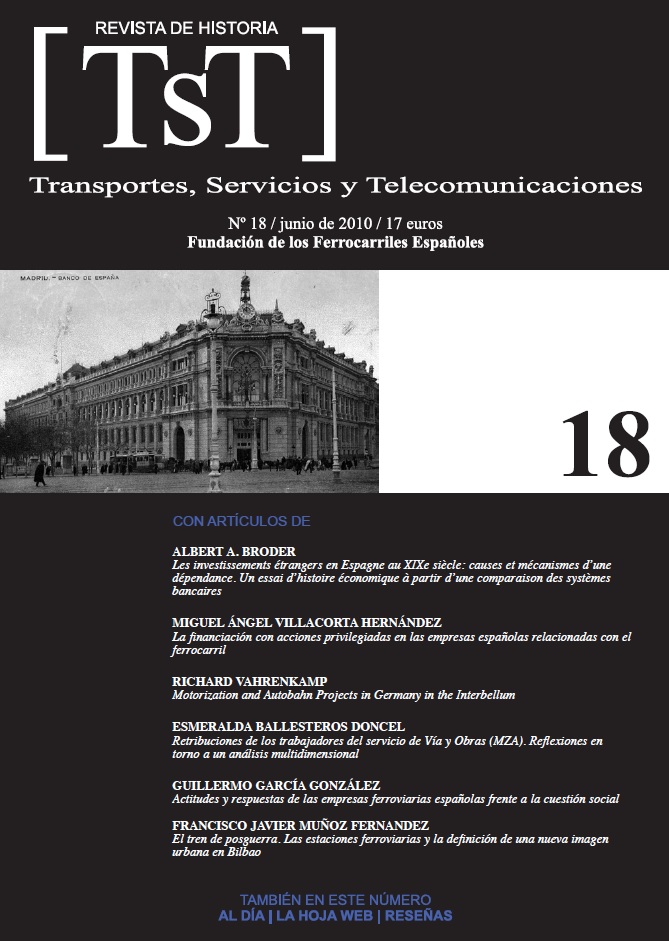
TsT18. 2010.
Dossier
♦ Albert A. Broder
Les investissements étrangers en Espagne au XIXe siècle: causes et mécanismes d’une
dépendance. Un essai d’histoire économique à partir d’une comparaison des systèmes
bancaires
Resumen:
Este ensayo, que es el resultado de una conferencia, trata de arrojar luz sobre el papel de las inversiones francesas en la economía española del siglo XIX, particularmente en el establecimiento de la red ferroviaria, a partir del hecho de que esta importante intervención es una consecuencia de la creencia de los franceses en su superioridad técnica, encontrando la insuficiencia de capital y capacidad industrial disponibles en España. Hemos intentado a través de tres síntesis sucesivas, conocer la función del banco en la inversión ferroviaria en Inglaterra, Alemania y Francia, poner de relieve los orígenes y problemas de la escasez de capital disponible en España y los efectos de la salida de capital sobre la economía francesa. El ensayo concluye con algunas explicaciones sobre la retirada del capital francés y de su ausencia en la etapa de inversión de las industrias tecnologícas modernas en la España de las primeras décadas del siglo XX.
♦ Miguel Ángel Villacorta Hernández
La financiación con acciones privilegiadas en las empresas españolas relacionadas
con el ferrocarril
Resumen:
Durante el siglo XX las empresas ferroviarias españolas se financiaron a través de instituciones bancarias o con la emisión de empréstitos, utilizando en mucha menor medida las acciones ordinarias y, de forma casi testimonial, las clases de acciones. Por el contrario, las clases de acciones sí fueron frecuentemente utilizadas como método de inversión-financiación en otros países. Esta investigación pretende detallar las posibles ventajas que hubieran supuesto, para las compañías españolas relacionadas con el ferrocarril, la financiación por medio de acciones privilegiadas, acciones preferentes, acciones sin voto y acciones rescatables.
♦ Richard Vahernkamp
Motorization and Autobahn Projects in Germany in the Interbellum
Resumen:
Este artículo aborda la evolución de las autopistas en Europa durante las décadas de 1920 y 1930. Se centra en los diversos proyectos y en el debate sobre una red europea de autopistas, así como en el papel desempeñado por la asociación Hafraba, que en Alemania fue significativo. Muestra, asimismo, cómo se desarrolló el concepto de autopista a partir de las existentes en Italia hasta el diseño de las Autobahns Francfort-Mannheim y Bonn-Colonia y la concepción del proyecto de la Autobahn Nazi. Explica, por último, que el rápido inicio de este último en 1933 se debió a los trabajos preliminares de la asociación Hafraba.
♦ Esmeralda Ballesteros Doncel
Retribuciones de los trabajadores del servicio de Vía y Obras (MZA). Reflexiones en torno a un análisis multidimensional
Resumen:
El estudio de las retribuciones debe abordar, simultáneamente, la cuantificación de las remuneraciones y el contexto de recepción de las mismas, teniendo en cuenta las condiciones de trabajo de las personas que las reciben. La utilización de un enfoque multidimensional favorece la compresión y el significado de las estadísticas retributivas. En el caso de los obreros del Servicio de Vía y Obras de la compañía MZA, en 1915 sus retribuciones resultaron insuficientes como salario familiar. Sin embargo, la prestación laboral se realizaba con incuestionable exigencia: largas jornadas, desplazamientos a pie, trabajo a la intemperie, peligrosidad e invisibilización del esfuerzo, y discriminación salarial en el caso de las mujeres.
♦ Guillermo García González
Retribuciones Actitudes y respuestas de las empresas ferroviarias españolas frente a la
cuestión social
Resumen:
Los desequilibrios surgidos en el siglo XIX entre los procesos de producción y las condiciones de vida de los trabajadores no tuvieron en España ninguna respuesta normativa eficaz hasta el año 1900. En este contexto cobran especial relevancia las actuaciones preventivas, protectoras y prestacionales que algunas empresas implantan voluntariamente a favor de sus empleados durante el siglo XIX, con el fin de paliar la inacción del legislador ante la denominada cuestión social.
El artículo analiza algunas de las medidas concretas establecidas por las empresas ferroviarias españolas a favor de sus empleados, y el modo en el que las mismas se articulan con el fin de mitigar las consecuencias generadas para los trabajadores en el nuevo modelo de relaciones productivas originado a raíz de la revolución industrial. En concreto, la investigación se centra en las actuaciones que realizaban las compañías de ferrocarril con relación a la salud laboral, los accidentes de trabajo y las pensiones de retiro. El estudio demuestra cómo las empresas ferroviarias se adelantaron medio siglo a la acción normativa del Estado, estableciendo políticas de salud laboral novedosas e implementando sistemas de protección pioneros.
Patrimonio Histórico
♦ Francisco Javier Muñoz Hernández
La arquitectura del ferrocarril de posguerra en Bilbao. Las estaciones ferroviarias
y la concreción de una nueva imagen de ciudad
Resumen:
Tras terminar la Guerra Civil, el Estado tuvo que afrontar la reconstrucción, construcción y reorganización de los sectores productivos y energéticos, así como de las infraestructuras y servicios más básicos, que acometió desde la Dirección General de Regiones Devastadas y el Ministerio de Obras Públicas. Estas tareas se complementarion con una labor de propaganda, que fue crítica con la actuación del gobierno democrático anterior y ensalzó el trabajo del nuevo régimen que, aparentemente, era capaz de resurgir de sus cenizas y construir un nuevo Imperio. Sin embargo, fue una actitud con la que se quiso ocultar la carencia de medios económicos, materiales y humanos para afrontar la posguerra, y se acompañó de una política autárquica inicialmente contraria al crecimiento de grandes enclaves urbanos, como la ciudad de Bilbao. En consecuencia, las reformas que se llevaron a cabo no respondieron a un plan de conjunto que centralizara los servicios ferroviarios o mejorara las comunicaciones del transporte de mercancías y personas de los municipios cercanos que configuraban el área metropolitana de Bilbao. En realidad, se limitaron a la construcción de dos nuevas estaciones que, junto con otros edificios públicos, contribuyeron a definir una nueva imagen urbana propia de una época igualmente nueva.
Reseñas
♦ Leonardo Caruana de la Cagigas
Nuria Puig y Eugenio Torres, Banco Urquijo. Un banco con historia
♦ Antonio Santamaría García
Pilar Sa Leal (Ed.), Trocha 1435. Los ferrocarriles en Cuba
♦ Pedro Pablo Ortúñez
Magda Pinheiro (coordinadora), Railway modernization: an historical perspective
(19th and 20th centuries)
♦ Xabier Lamikiz
Henri Lapeyre, Una familia de mercaderes: los Ruiz. Contribución al estudio del comercio entre Francia y España en tiempos de Felipe II