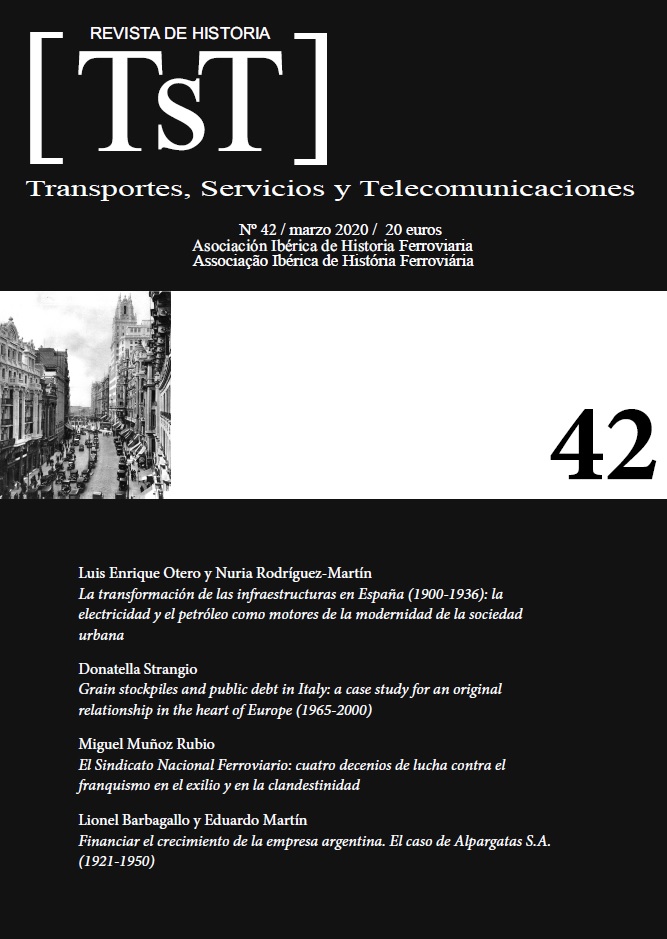
TsT42. 2020.
Articles
♦ Luis Enrique Otero and Nuria Rodríguez-Martín
The Transformation of Infrastructure in Spain (1900–1936): Electricity and Oil as Drivers of Modernity in Urban Society
Abstract:
Urban expansion in the first third of the 20th century was made possible by the emergence of the two energy sources that characterized the second wave of industrialization. Electricity—the energy that powered trains, streetcars, and the subway—and oil—buses, trucks, taxis, and automobiles—which drove public and private transportation systems in major urban centers. While electricity was crucial for urban mobility, it was no less important for the development of public lighting systems and the subsequent expansion of urban electrical grids. Likewise, it was crucial for the construction of Spain’s telegraph and telephone networks. Public lighting and urban transportation fueled the initial expansion of electrical grids, soon joined by consumption for industrial, commercial, and domestic purposes. Lower rates and agreements with city councils, transportation companies, and major industries facilitated the establishment of large electric utilities.
♦ Donatella Strangio
Grain Stockpiles and Public Debt in Italy: A Case Study of a Unique Relationship in the Heart of Europe (1965–2000)
Abstract:
This article aims to examine in greater detail a little-known aspect of grain reserves after World War II: the financial intervention related to mandatory reserves in Italy in connection with the financing of public debt. The transition from voluntary to mandatory reserves, although sharing some similarities in technical procedures, had different objectives: the former sought to protect producers, while the latter aimed to protect consumers; in the former, the organization and financing period centered on the private sector; in the latter, state intervention prevailed over the private sector, necessitating legislative measures. The state assumed responsibility for an ad hoc food rationing policy. Originally, the “storage note” was no different, from the standpoint of liquidity, from the “common note” that banks presented to the Bank of Italy for rediscounting, and the Bank of Italy, in accepting them for rediscounting, followed the same criteria used for accepting “common notes.” The management of compulsory storage was routinely completed throughout the year, as revenue from product sales was usually sufficient to cover operating costs and, conversely, to repay bank loans and, consequently, any loans from the Bank of Italy. It was subsequently established that financing was agreed upon annually with the relevant ministries for the entire amount of bills issued by the Bank of Italy that it had committed to rediscount. With the entry into force of the European Economic Community.
♦ Miguel Muñoz Rubio
The National Railway Union: Four Decades of Struggle Against Francoism in Exile and in Hiding
Abstract:
The historiography of railway workers’ organizations during the Franco regime is practically nonexistent. The purpose of this article is to provide an initial overview of the history of one of the two major railway unions: the National Railway Union (SNF). Affiliated with the UGT, the SNF, after having played a dominant role during the first third of the 20th century, collapsed as a result of Francoist repression; however, the article also analyzes the influence that other specific circumstances arising from the 1934 uprising had on this outcome. Second, the study examines how the union reorganized itself both in exile and within the country, and, in particular, what its main resources were. Finally, it examines the main strategies and tactical options it employed over the course of these four decades to survive and fight against General Franco’s dictatorship.
♦ Lionel Barbagallo and Eduardo Martín
Financing the Growth of Argentine Companies: The Case of Alpargatas S.A. (1921–1950)
Abstract:
In recent years, the analysis of organizations’ accounting, financial, and economic situations has been revitalized within business studies. In particular, both board minutes and balance sheets have been rediscovered as valuable sources. At the same time, economic history has returned its attention to the behavior of securities markets, encompassing both public and private securities. Consequently, it is of interest to observe and analyze the economic performance of a major Argentine company that was listed on the Buenos Aires Stock Exchange. Fábrica Argentina de Alpargatas S.A. is a company that began operations in the textile industry in 1884. Its growth and expansion attracted the attention of historians, both because it was a textile firm that emerged during the heyday of agro-exports and because of its success. This study analyzes the company’s annual reports and balance sheets to reconstruct its economic evolution during several critical periods: the 1920s, the crisis of the 1930s, and the Peronist era (1946–55). This will demonstrate that the company’s significant growth was financed through the market, without resorting to reinvestment of profits. Finally, its performance will be compared with that of other major industries of the period.
Reviews
♦ Jesús Mirás Araujo
Juan Manuel Matés-Barco and José Juan Pablo Rojas, Water and Public Services in Spain and Mexico
♦ Miguel Muñoz Rubio
Mercedes Fernández-Paradas and Carlos Larrinaga, The Impact of the Spanish Civil War on the Tertiary Sector
♦ Santiago de Luxán Meléndez
Miguel Suarez Bosa, The Port of Casablanca in the 20th Century: A Source of Development for Morocco
♦ Juan Manuel Matés-Barco
Germán Rueda, Isabel II (1830–1904). A Brief Biography