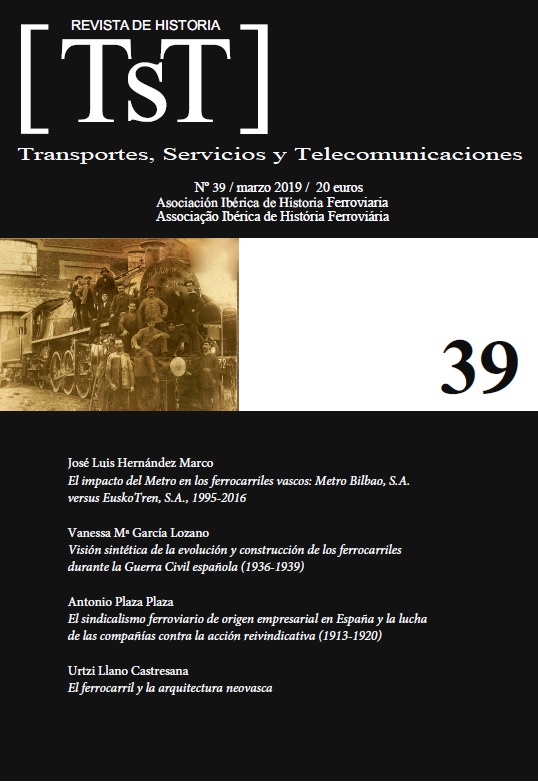
TsT39. 2019.
Articles
♦ José Luis Hernández Marco
The Impact of the Metro on Basque Railways: Metro Bilbao, S.A. versus EuskoTren, S.A., 1995–2016
Abstract:
After introducing the topic of the transfer of the railways to Basque institutions in 1978, the creation of the Vizcaya Transportation Consortium in 1974, and the institutional-business framework that would manage both the transferred railways and the construction and operation of the future Bilbao Metro, Section 2 of this article examines, for the first time, the detailed financing of its construction during the period 1987–2014, and then, in Section 3, analyzes the period during which the two companies managing the services—Eusko Trenbideak (EuskoTren) S.A. and Metro Bilbao S.A.—operated concurrently between 1996 and 2016. Section 4 analyzes the profitability and productivity—based on consolidated financial statements—of Euskotren (including ETS since 2005) and CTB-Metro Bilbao, both for each company over time—1994, 1997, and 2016 for Euskotren, and 1997 and 2016 for Metro Bilbao—and a direct comparison between them for the latter two dates. The study concludes with a set of conclusions.
♦ Vanessa Mª García Lozano
An Overview of the Evolution and Construction of the Railways During the Spanish Civil War (1936–1939)
Abstract:
During the Civil War, the railway network was divided into two zones. This division, which was initially balanced, would evolve as the rebel forces occupied most of the peninsula.
The strategic importance of the railroad as the primary backbone and means of transportation in Spain at the time led both sides to rush to build new sections of infrastructure under extremely adverse conditions, with the aim of restoring continuity to the lines that had been interrupted, thereby enabling the transport of both freight and passengers, as well as supplies to the front lines and military transport.
By the end of the conflict in 1939, the crisis and the railway problem had worsened due to the numerous material and economic losses suffered by a severely depleted sector, leading to the nationalization of the Spanish railway network.
♦ Antonio Plaza Plaza
Company-Led Railway Unionism in Spain and the Companies’ Struggle Against Labor Protests (1913–1920)
Abstract:
The call for the September 1912 strike by the Catalan Section of La Unión Ferroviaria, which was joined by the socialist railway union, prompted the railway companies to fight against it. La Unión Ferroviaria (UGT). By establishing first Catholic unions and later pro-management organizations, the railroad companies sought to curb the demands promoted by La Unión Ferroviaria (UGT) since 1909—which called for improved working conditions for railroad workers, wage increases to offset rising prices, and recognition of the right to organize. Although this right was recognized by law, in practice it was not respected by the companies. Commonly known as “yellow unions,” these organizations were used by the companies during the strikes of 1912, 1916, and 1917. Once the resistance of the socialist railroad unions—the FNFE—had been crushed, the companies benefited from the support of pro-business organizations, using them to increase pressure on the government.
♦ Llano Castresana
The Railroad and Neo-Basque Architecture
Abstract:
The late 19th and early 20th centuries were characterized by an abundance of architectural styles and approaches that could be summarized as an open conflict between form and function, of which railway architecture became the foremost example. In a historicist, post-Romantic context with evident “revival” influences, the first regionalist movements emerged in Spain, drawing on the characteristic features of the region’s building traditions and aesthetics, giving rise in the northeastern region to a style known as Neo-Basque. This style would enable interesting adaptations of reference typologies to the railway world, leading to the consolidation of Neovasco as a railway style as well. The purpose of this article is to analyze the impact and evolution of Neovasco on railway architecture, from its beginnings to its expansion beyond the boundaries that, a priori, might be considered the area of influence of this style. Furthermore, this study aims to provide a broader and more comprehensive perspective on this style, highlighting aspects of Neovasco railway architecture.
Reviews
♦ Antonio Santamaria García
Jorge D. Tartarini et al., Railway Architecture in Latin America: Cuba and Argentina
♦ Begoña Villanueva
Luis Dan Schill, Rita Kirk, and Amy E. Jasperson (Eds.), Political Communication in Real Time: Theoretical and Applied Research Approaches