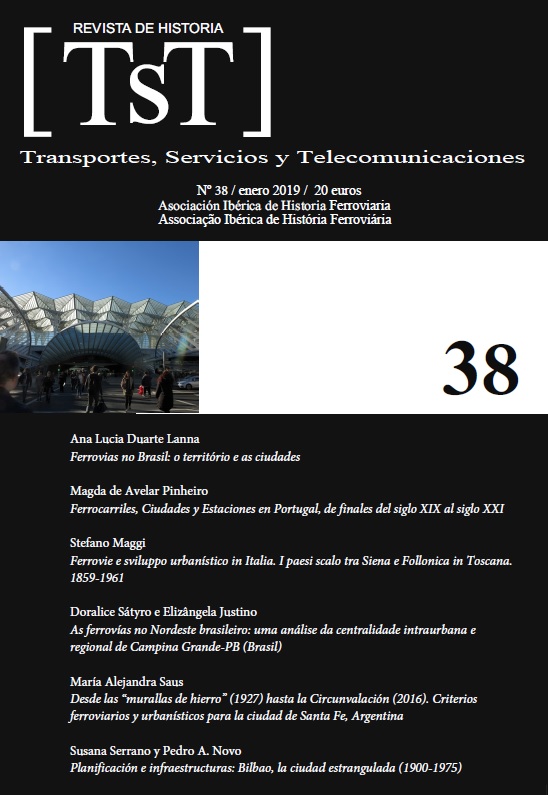
TsT38. 2019.
Artículos
♦ Ana Lucia Duarte Lanna
Ferrovias no Brasil: o território e as cidades)
Resumen:
El artículo pretende presentar algunas de las articulaciones entre expansión ferroviaria, consolidación del territorio y estructuración de ciudades en Brasil, indicando la pluralidad y complejidad de los caminos recorridos entre finales del siglo XIX y primeras décadas del siglo XX. Para ello utilizamos, además de la bibliografía, una vasta documentación que incluye historias locales, noticias de prensa, informes anuales de las compañías ferroviarias, informes consulares franceses, informes de agentes comerciales. La asociación entre ferrocarriles, velocidad, movilidad y progreso constituyó una pieza central en la construcción de las representaciones sobre la modernidad. La investigación revela que las condiciones previas y las particularidades de cada localidad interfirieron de forma decisiva en los significados que el ferrocarril trajo para la organización del espacio urbano. Creando ciudades como en el Noroeste, definiendo ciudades industriales como en Jundiaí, formando parte de la constitución de una metrópoli como en Campinas y São Paulo, los impactos son innegables pero distintos.
♦ Magda de Avelar Pinheiro
Ferrocarriles, Ciudades y Estaciones en Portugal, de finales del siglo XIX al siglo XXI
Resumen:
Este artículo relaciona la construcción de las estaciones ferroviarias con las teorías y las prácticas del planeamiento urbano. Se trata de ubicar el lugar de las estaciones ferroviarias en el urbanismo moderno enseñado en las escuelas, bajo la influencia del movimiento Ciudad-Jardín o en las ideas urbanísticas de los arquitectos que se organizaron en los Congresos Internacionales de Arquitectura Moderna (CIAM). Las New Towns de los años posteriores a la Segunda Guerra Mundial procuraron conciliar los dos movimientos y, en ellas, las estaciones tenían un lugar central. Las estaciones ferroviarias ganaron nuevas funciones y nuevos modelos arquitectónicos, sobre todo en las Villes Nouvelles de París. En busca de un enfoque comparativo, se estudia específicamente el caso portugués desde finales del siglo XIX hasta principios del siglo XXI.
♦ Stefano Maggi
Ferrovie e sviluppo urbanístico in Italia. I paesi scalo tra Siena e Follonica in Toscana. 1859-1961
Resumen:
Durante el siglo XIX, el ferrocarril trajo los mayores cambios, también debido al hecho de que Italia tiene un territorio en gran parte montañoso. Incluso en las antiguas ciudades portuarias, las vías se extendieron desde los muelles hasta los límites de las áreas construidas y se construyeron grandes estaciones marítimas que movieron las mercancías, contribuyendo también al crecimiento urbano. En el campo, las vías del ferrocarril a lo largo de los valles del río atrajeron a los residentes de los centros medievales en las colinas, y se construyeron nuevos asentamientos alrededor de las estaciones, el llamado “paesi scalo” (países ferroviarios).
La estación de tren era algo completamente nuevo en comparación con las viejas estaciones de correos, que se encuentran en el corazón de las ciudades y se integra en los centros históricos. Desde la década de 1840, las principales ciudades italianas sufrieron un cambio urbano, causada por la construcción de la cabeza o las estaciones de tránsito. Este artículo analiza la ubicación de las estaciones en dos ciudades italianas, una ciudad medieval y una ciudad portuaria, Siena y Follonica.
♦ Doralice Sátyro e Elizângela Justino
As ferrovías no Nordeste brasileiro: uma análise da centralidade intraurbana e regional de Campina Grande-PB (Brasil)
Resumen:
Los ferrocarriles constituyen elemento técnico representativo del impulso dado a la industrialización y a la urbanización en el siglo XIX. Este sistema de transporte fue implementado en Brasil a lo largo del siglo XIX y, de forma más efectiva, en el inicio del siglo XX. El objeto de análisis de esta investigación es el ferrocarril de la ciudad de Campina Grande, localizada en el Noreste brasileño. Los ferrocarriles introducidos en el interior del territorio brasileño tuvieron como principal función el transporte de los productos agropecuarios. El propósito principal es revelar la importancia de este objeto técnico para la consolidación de la ciudad de Campina Grande como centro regional, así como para la conformación de su área central. Se trata, pues, de una investigación en la perspectiva de dos escalas geográficas: urbana y regional, o la intraurbana y la interurbana. Las principales fuentes documentales primarias utilizadas fueron: los informes, discursos y mensajes de los presidentes de las provincias y/o del Estado de Paraíba, informes del Ministerio de Industria, Vía y Obras Públicas y la Estadística de las Vías Férreas de la Unión y de aquellas inspeccionadas por la Unión.
♦ María Alejandra Saus
Desde las “murallas de hierro” (1927) hasta la Circunvalación (2016). Criterios ferroviarios y urbanísticos para la ciudad de Santa Fe, Argentina
Resumen:
Los ciclos de uso de las infraestructuras ferroviarias y los paradigmas del urbanismo definen unidades históricas que marcan discontinuidades durante los siglos XX y XXI. Cada uno de esos períodos cristalizan fases de expansión material del capital con efectos urbanos específicos debidos a las políticas públicas de transporte. Este artículo aborda el caso de la ciudad de Santa Fe y estudia cinco planes urbanos con dos objetivos concomitantes: uno sincrónico y otro diacrónico. El primero describe los criterios ferroviarios y urbanísticos reunidos por cada plan, mientras el segundo los sitúa en la evolución del binomio ferrocarril-ciudad. Usando la metodología del análisis documental, el trabajo se divide en dos partes. La primera presenta el caso y es un panorama de las historias del ferrocarril y del urbanismo en la Argentina. La segunda examina los planes santafesinos tomando al ferrocarril como problema y oportunidad.
♦ Susana Serrano y Pedro A. Novo
Planificación e infraestructuras: Bilbao, la ciudad estrangulada (1900-1975)
Resumen:
Si aceptamos el axioma de que las infraestructuras de comunicaciones influyen en el desenvolvimiento de las ciudades y que los medios estructurales que lo hacen posible determinan la propia forma de éstas, el objetivo del presente artículo es analizar los déficits generados por éstas, en relación con la trama urbana, para abordar de forma paralela las soluciones aportadas en la planificación de la comarca del Gran Bilbao durante la primera mitad del siglo XX y que no llegaron a materializarse hasta la década de los ochenta y noventa.
Reseñas
♦ Nuria Rodríguez Martín
Vicente Pinilla, Luis Germán y Agustín Sancho, El transporte público en Zaragoza. Desde 1885 hasta la actualidad
♦ Jesús Mirás Araujo
Luis López Molina (director), Teresa Pontón y María Vázquez (coordinadoras), Cádiz: del Floreciente s.XVIII al Port of the Future del s.XXI