4th Conference on Railway History, University of Valladolid.
"Bicentennial of the Stockton-on-Tees–Darlington Railway”:
—its first echoes in Spain.”
June 12, 2025.
Conference Room of the Faculty of Economics and Business,
University of Valladolid.
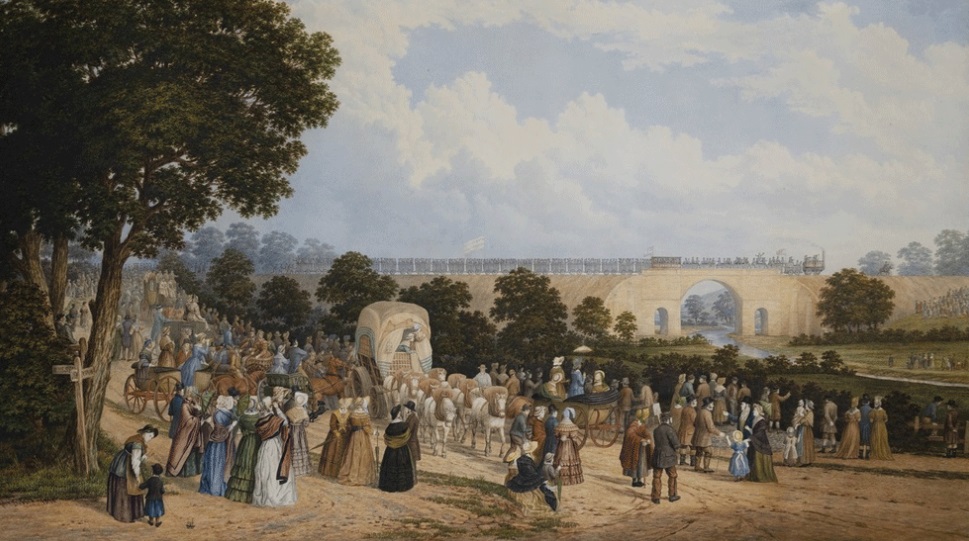
September 27 marks the bicentennial of the opening of the world's first public railroad between Stockton-on-Tees andDarlington (United Kingdom). This event was a milestone in English history. From that point on, a continuous timeline unfolded that made the railroad a key element of nineteenth-century industrialization and established it as the essential mode of transportation for the economic modernization of the rest of the world.
The University of Valladolid, the Simancas University Institute of History, the FFE, the AIHF and ASIHF have deemed this a fitting occasion to dedicate the “4th University of Valladolid Railway History Conference” to examining the initial repercussions that this event had on the early days of railroads in Spain. To this end, we have prepared a program for this 4th Congress, which is is free to attend until capacity is reached, consisting of four presentations by various historians:
-Miguel Muñoz Rubio (ASIHF): “Marcelino Calero, the Liberal Freemason Who Brought the Railroad to Spain.”
Marcelino Calero, born in Badajoz on January 16, 1778, was a liberal Freemason who, from his exile in London, would introduce the railroad to Spain. He did so, on the one hand, through a failed attempt to build and operate a railroad between Jerez de la Frontera and El Puerto de Santa María; and, on the other hand, by promoting—through the Seminar on Agriculture and the Arts—the modernizing role of this mode of transportation and the major advances taking place in England. The lecture will argue that Calero’s role was fundamental in paving the way for railway development in Spain years later.
-Juan Carlos Ponce (ASIHF): “Railroads and Progress: Early Literary Accounts in Spain.”
The construction of the first railroads in Europe marked a fundamental shift in the way people conceived of communication, social interaction, and commercial relations. At the same time, the first literary works featuring the railroad as a central theme began to emerge, and despite some traditionalist misgivings, poets and novelists extolled the new mode of transportation as the primary symbol of progress.
In Spain, around 1840, the first literary accounts were published by writers who traveled beyond our borders and recounted in the first person their discovery of the earliest railroads. During the transition from Romanticism to Realism, writers such as Mesonero Romanos, Modesto Lafuente, and Jacinto Salas y Quiroga emerged, continuing the tradition of travel literature pioneered by the travelers of the Enlightenment. While those 18th-century pioneers, on horseback and in their stagecoaches, undertook their journeys with the aim of conducting research and expanding knowledge in various scientific disciplines, our post-Romantic travelers made train travel the central theme of some of their finest works, using it as a true source of inspiration.
Mesonero Romanos, a chronicler of urban life, travels to France and Belgium to see the locomotives and grand train stations firsthand. Similarly, Modesto Lafuente, a famous satirical journalist and historian, provides us with splendid scenes of rail travel throughout northern Europe—inspired by genre painting—in his work *Viajes de Fray Gerundio*. And Salas y Quiroga travels between Havana and Güines to explore the island of Cuba, specifically along the line considered to be the first Spanish railroad outside the Iberian Peninsula.
We will draw on the early accounts of these three writers to examine how the railroad and train travel were viewed as symbols of progress in nineteenth-century society.
Francisco de los Cobos(professor at the University of Castilla y La Mancha): “The Dissemination of the First Technical Treatises on Railroads in Spain.”
The first technical manuals on railroads in Spain emerged as translations of works by prominent European engineers, such as the British engineer Tredgold and the German engineer von Gerstner. These editions, supplemented with introductions and personal notes, sought to disseminate international technical knowledge and adapt it to the Spanish context.
In a second phase, linked to the construction of the first railway lines, the manuals written by French engineers—who played a role in training Spanish railway companies—became established as standard references. Although this flow of knowledge influenced the training of Spanish engineers, its impact on specialized Spanish literature was limited, with few exceptions of original contributions, such as those made by some inventors.
–Francisco Polo Muriel (FFE):“Discovering a New Era in Land Transportation Through the Earliest Documents Preserved by the Historical Railway Archive and the Railway Library of the Spanish Railways Foundation.”
The documentary legacy preserved by the Spanish Railways Foundation (FFE) through its Historical Railway Archive and Railway Library consists of nearly 5,000 linear meters of historical documentation, more than 70,000 bibliographic volumes and 80,000 newspaper clippings, as well as a photographic collection containing more than 400,000 images. These collections date back to the early days of railroads in Europe and cover a variety of topics: early technical treatises on railroads, reports on the beginnings of this new mode of transportation, operational reports from the first railroad companies established in Spain, and archival records that document the earliest traces of this new mode of rail transportation in our country. This presentation aims to highlight the oldest and most representative documents in our collections, placing them within the context in which they were created.
PROGRAM
10:15.Opening Remarks: María Concepción Porras Gil (Director of the Simancas Institute of History, University of Valladolid) and María del Valle Santos Álvarez (Dean of the School of Economics and Business, University of Valladolid).
10:30. Presentation: Pedro Pablo Ortúñez Goicolea (Professor at the University of Valladolid)
11:00 a.m.Coffee break.
11:30 a.m.Miguel Muñoz Rubio (ASIHF): “Marcelino Calero, the Liberal Freemason Who Brought the Railroad to Spain.”
12:00 p.m. Juan Carlos Ponce (ASIHF):“Railroads and Progress: Early Literary Accounts in Spain.”
12:30.Francisco de los Cobos (University of Castilla-La Mancha): “The Dissemination of the First Technical Treatises on Railroads in Spain.”
1:00 p.m. Francisco Polo Muriel (FFE):“Discovering a New Era in Land Transportation Through the Earliest Documents Preserved by the Historical Railway Archive and the Railway Library of the Spanish Railways Foundation.”
1:30 p.m.Discussion.
ORGANIZERS