Biographical Dictionary of Iberian Railways
Biographical Dictionary of Iberian Railways
Ángel Torán Tomás (Madrid, 1921–Biarritz, 1999)
Ángel Torán Tomás. A Spanish industrial engineer responsible for the technical innovations of the TALGO train.
Ángel Torán graduated from the Special School of Industrial Engineering in Madrid in 1946, and at the end of that same year he received a scholarship from the Spanish Ministry of Foreign Affairs to study in the United States the application of articulated and light rail systems. Before his stay ended, he was hired by Patentes Talgo S.A. to join the team of engineers tasked with building the first Talgo train to enter service on Renfe’s passenger lines (1).
This project was named Talgo II in reference to the two prototypes (Talgo 0 and Talgo I) that financier José Luis de Oriol had built in Spain to test the feasibility of several innovative ideas by military engineer Alejandro Goicoechea; this is the origin of the acronym TALGO: Tren Articulado Ligero Goicoechea Oriol (Goicoechea-Oriol Light Articulated Train). The idea was to improve both the safety and the speed and cost-effectiveness of the railway: cars that were lighter than existing ones but would not derail thanks to a system of independent wheels that completely changed the relationship between the rail and the wheel, resulting in improved safety, less wear on the track, and lower maintenance costs. This new type of running gear would be fitted to aluminum cars, resulting in lower manufacturing costs and reduced traction costs.
To develop these ideas and turn them into a commercial train, Patentes Talgo S.A. was founded in 1942. It was a very bold venture, as it set out to modernize every aspect of railway rolling stock construction at a time when the railroad was in decline due to competition from automobiles and airplanes. Furthermore, all technical and design principles were developed without the support of any direct precedents.
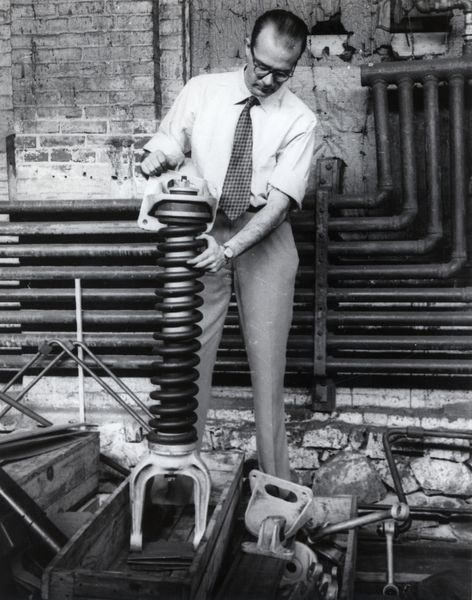
In early 1944, Goicoechea left the company and ICAI engineer Jaime McVeigh was hired; he was the one who drafted the preliminary design for the first Talgo intended for commercial use, the Talgo II.
The construction of that first commercial version of the Talgo took place at the American Car and Foundry workshops in the U.S., following Jaime McVeigh’s preliminary design. In 1946, the team of American engineers was joined by ICAI engineer Francisco Fernández de Heredia, who was assigned to implement the electrical system for the new train’s locomotive, and industrial engineer Ángel Torán, who oversaw the construction and verification of the structure—that is, the design of the car body and the running gear of the new train.
In November 1949, the first 32 Talgo II passenger cars and three locomotives arrived in Spain. New units would continue to arrive until 1958. In addition to their revolutionary mechanics and innovative design, they were the first air-conditioned cars in Europe; they were all first-class, featured a panoramic lounge at the rear of the train, and could travel safely at 170 km/h, although to comply with regulations they did not exceed 120 km/h (and even then, only on sections where the dilapidated postwar Spanish rail network permitted it). These figures made it the fastest train in Europe.
The Talgo II’s corrugated aluminum cars, initially built in aeronautical workshops and featuring a design of the highest quality, left behind the nineteenth-century aesthetics of rail travel. In fact, Talgo incorporated the aesthetics of the early twentieth-century avant-garde into every detail and the overall design of the train.
In 1950, the Talgo II began operating on the Madrid-Hendaye line and was gradually incorporated into other services as new units arrived from the United States.
That same year, Jaime McVeigh left Patentes Talgo, and Ángel Torán took charge of the technical team, beginning the development of a powerful research and development department that would become the defining feature of the company, alongside a smart business strategy that gradually adapted to the needs of the Spanish railway administration. Talgo supplied RENFE with high-quality passenger cars and retained responsibility for fleet maintenance, which provided an exceptional test bed: the daily experience of operating the trains. Ángel Torán’s technical expertise and creative talent could then be focused on continuously improving the performance of the Talgo II, modifying and refining the initial designs based on the trains’ day-to-day performance.
These improvements grew in significance and, over time, gave rise to several generations of Talgo trains that incorporated Ángel Torán’s successive patents: the Talgo III, the Talgo III-RD, and the Talgo pendular.
In the early years of operation, Ángel Torán focused on resolving one of the Talgo’s greatest limitations up to that point: its inability to run in reverse. The Talgo II could only run in one direction because the wheel-guidance system devised by Goicoechea prevented a change in direction, which posed a serious operational drawback, as the train required complicated maneuvers upon arrival at and departure from stations.
In 1958, Torán proposed a new wheel-guidance system—known as “zero-angle-of-attack guidance”—that allowed Talgo trains to travel in both directions; this, along with other advances in safety, stability on curves, and passenger comfort, facilitated the commercial expansion of the system. This improvement and five other patents by Ángel Torán so substantially altered the train’s characteristics that the new model incorporating them in 1964 came to be known as the Talgo III.
As director of the Talgo III’s development and inventor of the six patents that defined this model, Torán was able to submit this project to earn his Doctor of Engineering degree from the Polytechnic University of Madrid.
Ángel Torán’s following landmark patents for Talgo were registered in February 1966 and concerned a “Method for the rapid adaptation of railway vehicles to different track gauges” (patent 3233669). When it was decided in 1845 that the track gauge in Spain would be 1672 mm (the European network used 1435 mm), two reasons were cited: that Spain’s challenging terrain would require locomotives with larger steam boilers than in other countries, and the European trend toward building relatively wide tracks, especially in Russia and England. That decision isolated Spain from the rest of continental Europe. Crossing the border into France by train required a series of maneuvers that delayed and complicated travel. And in the case of luxury passenger trains—Talgo’s specialty—such delays were unacceptable.
In June 1966, Ángel Torán set Talgo’s technical team to work on a project to solve this challenge, and three years later, after many ideas had been set forth in reports and blueprints, laboratory tests, verification of results, and fine-tuning of the design using full-scale prototypes of the various mechanisms, confidence in the mechanism’s success was such that the design and manufacture of an Experimental Train with a Sliding Running Gear—comprising four cars of international gauge—proceeded simultaneously with this research and testing work.
In October 1967, the experimental train was unveiled to the national and international press. From that point on, track testing began in both France and Spain. The system passed, in record time, the rigorous tests that railway practice requires for any innovation.
Finally, on November 12, 1969, the experimental Talgo train, equipped with automatic adaptation to the European track gauge, traveled from Madrid to Paris. On the section from Hendaye to Paris, it exceeded 160 km/h. The mechanism devised by Ángel Torán allowed for a simple and automatic change in track gauge, requiring nothing more than a locomotive change, thereby saving two hours compared to service with conventional trains.
The final series of patents that definitively secured Ángel Torán’s place in the history of Spanish technology were those related to the tilting suspension system in 1980, which, by allowing the train to tilt appropriately when negotiating curves, paved the way for high-speed operation of Talgo trains (2).
Teresa Sánchez Lázaro,
June 2026.
Notes
[1] For more biographical information on Ángel Torán, see Valbuena Vázquez, Pablo, “Ángel Torán Tomás, ” in *History of the Higher Technical School of Industrial Engineering of Madrid from 1901 to 1972*, https://patrimonio.industriales.upm.es/angel-toran-tomas/.
[2] In the documentary *Ángel Torán: 101st Anniversary* (2022), Ángel Torán himself explains the pendular suspension system in a historical recording; this can also be found at https://patrimonio.industriales.upm.es/angel-toran-tomas/.