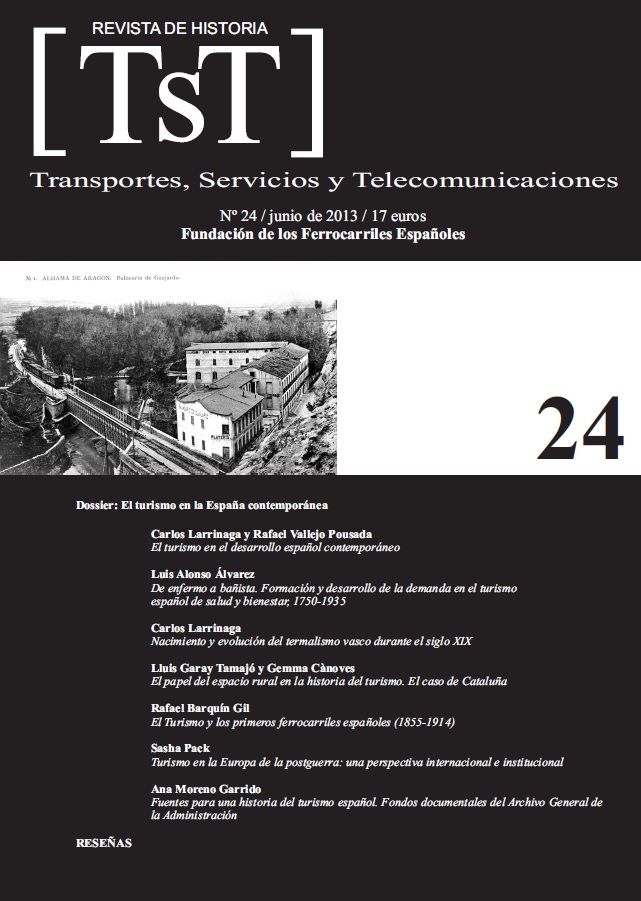
TsT24. 2013.
Dossier
Tourism in Contemporary Spain
♦ Carlos Larrinaga and Rafael Vallejo
Tourism in Contemporary Spanish Development
Abstract:
This paper presents the main trends in the evolution of tourism in contemporary Spain, tracing its development into a significant sector of the country’s socioeconomic structure. It also provides evidence of the disparity between tourism’s importance and the scant academic attention it has received in Spain, particularly in the field of economic history. The available research, the authors conclude, has not been incorporated into general syntheses of economic, social, and cultural history, in which tourism appears almost as an episodic phenomenon, limited to the years of the “desarrollismo” era (1959–1975). Finally, the article synthesizes the contributions of those who have collaborated on this monograph and reviews the literature from recent years on Spanish tourism.
♦ Luis Alonso Álvarez
From Patient to Spa Guest: The Formation and Development of Demand in Spanish Health and Wellness Tourism, 1750–1935
Abstract:
After outlining the key historical stages of health tourism in Spain between 1750 and 2012, this study examines the various available statistical sources to determine the scale of demand among travelers visiting Spanish spas. Using these sources, a time series is reconstructed covering the period from 1849 to 1931, based on its four components: a) officially registered patients (the only ones appearing in earlier records); b) their companions and family members; c) the remaining unregistered spa guests; and d) patients not registered because they stayed at “clandestine” establishments.
♦ Carlos Larrinaga
The Origins and Evolution of Basque Thermal Tourism in the 19th Century: The Case of Guipúzcoa
Abstract:
This article is the result of research into the development of the Basque spa industry in the 19th century, focusing specifically on the case of Guipúzcoa, the region with the richest supply of mineral springs in Spain at that time. The aim, therefore, is to conduct a micro-level study focusing on such relevant aspects as institutional changes, ownership, and the capital invested in the spa sector. Thus, the objective of this work is to analyze how the spa industry was structured and how it evolved throughout the 19th century and into the early 20th century, when the spa industry entered a period of crisis. To this end, the author has drawn on original documents, notarial records, and Commercial Registry records; however, this approach has its limitations, as it does not allow for a complete reconstruction of the capital involved. Nevertheless, the originality of this work lies precisely in this reconstruction, viewed in comparison with investments made in other economic sectors.
♦ Luis Alfonso Garay Tamajón and Gemma Cánoves i Valiente
The Role of Rural Areas in the History of Tourism: The Case of Catauña
Abstract:
In recent years, tourism has played a significant role in the development of many rural destinations in our country. However, long before the emergence of generic rural tourism as we know it today, there were numerous forms of leisure and travel in rural areas whose importance has been decisive in the broader history of the tourism sector. The objective of this article is twofold. On the one hand, from an empirical perspective, to recover the historical record regarding the role of these essentially rural identity phenomena in the history of tourism; and on the other hand, from a conceptual perspective, to demonstrate the validity of the combined use of two approaches to the historical development of tourism: the Tourist Destination Life Cycle and Regulation Theory.
♦ Rafael Barquín
Tourism and the First Spanish Railroads
Abstract:
This paper has two objectives. First, it attempts to estimate the economic impact of tourism on the railroad industry in the second half of the 19th century. For the Norte Company—and only for that company—that impact appears to have been quite significant. Second, it seeks to determine to what extent the railroad influenced the development of the tourism sector and, in particular, the success or failure of certain tourist destinations. In general, the railroads satisfied latent demand but did not have a forward-looking impact on the tourism sector. For this reason, they were not a determining factor in the location of the major tourist destinations.
♦ Sasha D. Pack
Tourism in Postwar Europe: From Sterling Diplomacy to Mass Consumerism
Abstract:
This article aims to provide a concise overview of the role of states and international institutions in the development of tourism in Europe since World War II. Following a brief review of the relevant historiography on modern tourism as a transnational phenomenon, the article examines the emergence of state and intergovernmental institutions dedicated to promoting tourism in the early 20th century. While these institutions were typically conceived for nationalist purposes, the period following 1945 witnessed the first significant efforts to harness tourism in the service of a broad, multilateral project for the reconstruction and development of the European economy. The article examines the consequences and limitations of this project and offers some reflections on efforts to implement a similar program in the countries of the socialist bloc.
♦ Ana Moreno Garrido
Sources for a History of Spanish Tourism: Documentary Collections of the General Archive of the Administration
Abstract:
Reflection on sources is an integral part of the historian’s work. This is a fundamental issue in new historiographical approaches, such as the history of tourism. Undoubtedly, an initial exploration of the subject leads us to government sources, given the importance that public administration has played in the emergence and development of Spanish tourism. In this regard, the documentary collections of the General Archive of the State Administration are essential for research, not only because they span a very broad chronological range, but also because of their richness and complexity—which are directly linked to other non-tourism-related collections—allowing historians to go beyond a simple history of the Spanish tourism administration. This article explores the possibilities offered by the most important documentary collection for the history of Spanish tourism.
Reviews
♦ Rafael Vallejo Pousada
Luis Alonso Álvarez, Elvira Lindoso Tato, and Margarita Vilar Rodríguez, The Pleasure of the Waters: A History of Galicia’s Spas, 1700–1936
♦ Rafael Vallejo Pousada
Casal García and Silvia González Soutelo, The Spa Resorts of Galicia: Origins and Development
♦ Rafael Vallejo Pousada
Xosé Manuel Pereira Fernández, The Lérez Spa: Casimiro Gómez’s Thermal Adventure
♦ Carlos Larrinaga
Peter Borsay & John K. Walton (Editors), Resorts and Ports: European Seaside Towns since 1700
♦ Carlos Larrinaga
Eric G. E. Zuelog (Editor), *Tourism Beyond the Nation: A Transnational Approach to European Tourism History*
♦ Sasha D. Pack
Anne E. Gorsuch, *All This Is Your World: Soviet Tourism at Home and Abroad After Stalin*
♦ Nelly da Cunha
Elisa Pastoriza, The Conquest of Vacations: A Brief History of Tourism in Argentina
♦ Beatriz CorreyeroRuiz
Marc Cluet (Editor), German-Style Vacations: The German Origins of Green Tourism (1850–1950)
♦ Bernat Montoya Rubio
Joan Carles Cirer Costa, The Invention of Mass Tourism in Mallorca
♦ Ana Moreno Garrido
Sasha D. Pack, The Peaceful Invasion: Tourists and Franco’s Spain
♦ John K. Walton
N. da Cunha, R. Campodónico, M. Maronna, N. Duffau, and G. Buere, “Visit Uruguay: From Seaside Resort to Tourist Destination, 1930–1955”
♦ Carlos Patrizia Battilani
Annunziata Berrino, *History of Tourism in Italy*
♦ Rafael Vallejo Pousada
Carlos Barciela, Carles Manera, Ramon Molina, and Antonio Vittorio (Editors), The Evolution of the Tourism Industry in Spain and Italy
♦ Carlos Larrinaga
Cédric Humair and Laurent Tissot (Editors), Swiss Tourism and Its International Influence. “Switzerland, the Playground of the World”
♦ Juan José MolinaVillar
, Alonso Álvarez, Margarita Vilar Rodríguez, and Elvira Lindoso Tato, Healing Waters: Thermal Tourism in Spain, 1700–1936