Session IV
Railway History—Urban History.
Coordinators: Luis Santos and Ganges (University of Valladolid) and Doralice Sátyro Maia (Federal University of Paraíba, Brazil).
Sheila Palomares Alarcón (University of Jaén)
The Influence of the Railroad on the Design of the First Olive Oil Regulation Warehouses of the Sindicato Vertical del Olivo
In the mid-20th century, among the main sectors that characterized the Andalusian agri-food industry, the olive oil sector played a leading role. Although this was an industry that required oil mills to be located near the growing areas, the exponential increase in demand facilitated the modernization of the sector, an increase in production, and, consequently, the need for more space to store the oil.
Although historical accounts of the agri-food industry have not established a link between the olive oil industry and the railroad, the oil regulatory warehouses demonstrate otherwise. While it is true that most oil mills were located in production areas near road networks, at a time when efficient and rapid transportation was essential for moving large quantities of oil, rail transport was indeed considered a priority.
It was in this context that the network of oil regulatory warehouses of the Sindicato Vertical del Olivo emerged in 1945; the organization built twelve facilities by 1960 in three distinct phases, with the first phase being the focus of this research.
This paper aims to contribute to the history of railways by analyzing the importance of the railroad in determining the location of the Olive Vertical Syndicate’s olive oil regulatory warehouses, as well as in designing their architecture, since they were morphologically designed with the railroad tracks serving as their main “facade.”
Elvira Khairullina (University of Valladolid)
Tram Planning in New Residential Areas of the GDR, Czechoslovakia, and the USSR in the 1970s
During the postwar period, the tram was abandoned in favor of automobile transportation in most capitalist and socialist European countries. At the same time, rapid urbanization led to serious problems with traffic congestion and accessibility for residents. This strengthened the role of the tram in cities and accelerated the need for its integration into urban planning. In this context, the new housing program launched in the early 1970s in the countries of real socialism was seen as an opportunity to rethink transportation planning. However, a standardized approach was not achieved, and different concepts and solutions were developed.
The objective of this study is to understand why tram planning differed within the socialist system and how this affected the structure and layout of new residential areas. To this end, a comparative analysis will be conducted of theoretical studies, as well as urban and transportation plans and projects for the three residential areas: Gorbitz (Dresden, German Democratic Republic (GDR)), Líšeň (Brno, Czechoslovak Socialist Republic (CSR)), and Sykhiv (Lviv, the Soviet Union (USSR)). It is concluded that the differences in tram planning were influenced by varying levels of political control over urban planning, criticism of the Modern Movement, and the interrelationship between urban planning and transportation planning. As a result, the residential areas studied exhibit variations in the organization of tram lines and stops, which highlight differences in the priority given to trams and pedestrians.
Full Text
Federico Meneghini Sassoli (UNIPV, Italy)
Batignolles and Breda: The Organization of Urban Space Around Two Railway Construction Factories
The aim of this presentation is to present a work in progress that illustrates part of my current thesis, which focuses on the complex relationship between the city and the railway industries in Milan and Paris, entitled*Quando l’industria ferroviaria crea la città: flussi di merci, urbanizzazione e industrializzazione a Parigi e Milano (anni 1880 – 1910)*.
In this presentation, I aim to describe the spatial aspect of this research. I will examine the urban space surrounding these factories and the mechanisms behind its organization at the end of the 19th century. This organization was not merely a practical matter but also reflected a balance of power between public and private actors. A continuum of struggles and cooperation unfolded between theSociété de Construction de Batignollesand theSocietà Italiana Ernesto Breda per Costruzioni Meccaniche, on the one hand, and the two host cities—Paris and Milan, respectively—on the other. This evolving relationship is linked to the double-edged nature of the industrial plants. These two plants were, at the same time, a source of opportunity, wealth, and employment for the inhabitants. Yet they were also a source of pollution and noise and, above all, space-hungry facilities in constant search of new land for expansion.
The sources used come from two main channels: public administration sources in archives such as theArchives de la Ville de Paris, theArchives Nationalesin Paris, and theArchivio Civico Storico e Biblioteca Trivulzianain Milan. These sources reflect the city administration’s desire to control its space by limiting and regulating it. The second source consists of materials from the corporate archives in Roubaix and Sesto San Giovanni, respectively. These will illustrate the needs and intentions of the two companies.
Full Text
Javier Revilla (University of León)
100 Years of Narrow-Gauge Rail in the City of León: The “Matallana Station”
Since 1894, the locomotives of the “coal” railroad had been whistling between La Robla (León) and Balmaseda (Vizcaya), driven by Basque industrialists interested in transporting coal mined from the León coalfields to their factories. But they did not overlook the benefits of passenger transport either, so they soon connected it to Bilbao at one end and sought to extend it to León at the other.
The latter was delayed until May 1923, and with that, the city of León gained its second railway station. The broad-gauge station, inaugurated in 1863, was joined by the narrow-gauge station known as “Matallana Station,” named for its connection between León and Matallana de Torío—a junction with the coal train via a route of just 30 kilometers.
This narrow-gauge station, designed by Luis del Río, is now celebrating its centennial. Del Río chose a traditional style for the passenger terminal, which also featured tiled panels and a small iron canopy.
To mark this anniversary, this article will examine the ups and downs the station has experienced over the past century—a period during which we will trace the evolution of both the station and the city. We will also explain the plans that existed to connect it with other rail lines—something that ultimately never came to pass. And, with some relief, we will examine the attempts made at various times to demolish the passenger station building, as well as the new uses that some parts have been given, such as the two warehouses in the rail yard that have housed Espacio Vías since 2010—a dynamic cultural center for the youth of León.
We’ll conclude with a description of the station’s current state, as it has been “temporarily” awaiting the return of trains and passengers since September 2011, immersed in a never-ending process of integration right in the heart of the city of León.
Luciana Massami Inoue (UFSJ, Brazil)
The Western Minas Railway and Its Urban Impacts
This presentation is part of an ongoing research project on railroads in Minas Gerais, initially focusing on the Western Minas Gerais Railroad, a line that crosses the city of São João del-Rei, Minas Gerais—a city that played an important role during the mining era in colonial Brazil and possesses an industrial heritage, beyond the railroad itself, that deserves to be investigated.
The research takes as its starting point—and employs the same methodology—as that used in the doctoral dissertation on the history of the Companhia Paulista de Estradas de Ferro, which demonstrated the importance of that railway, along with other major railroads, in shaping the territory of São Paulo State, in relation to coffee, immigration, and the urbanization of these areas. This current study seeks to determine whether the railroad had the same importance and impact on the cities it traversed. Methodologically, it is grounded in history and corporate history, while also drawing on urban morphology to analyze these spaces.
Full Text
Daniel Marín Arroyo (JCCM // UNED)
A Railroad in the Middle of Nowhere: The Huerta de Valdecarábanos Station, Toledo
The Huerta de Valdecarábanos station, on the Madrid–Alicante line, was built during the expansion of the railroad from Aranjuez to Almansa. Since its construction 168 years ago, its relationship with the town of the same name has been complex. Huerta and its station are 8 km apart, which has led to the development of somewhat complex connections between the town and the railroad to take advantage of the railway. The station was the site of all kinds of trade; wine cellars were built to capitalize on the area’s vineyards; a specific MZA rate was established for the slow-speed transport of soda ash; there were fairly severe outbreaks of whooping cough and malaria in the railway workers’ quarters; and so on.
The proposal I submit for your consideration is to analyze the evolution of the Huerta de Valdecarábanos station and its surroundings, providing a comprehensive overview that examines the historical development of the railway buildings (the station’s relocation, the enclosure of the platform, the installation of the signal box, the open platform of the Bilbaínas warehouses, etc.) as well as the economic, social, political, and environmental relationship between the railway structures and the small Toledo town of Huerta de Valdecarábanos.
A heritage perspective on the station will also be provided, particularly to commemorate the buildings that, unfortunately, no longer exist today. A documentary appendix will be included, presenting the evolution of the floor plans of the Huerta station, as well as other documents of interest.
Full Text
Pablo Alonso Villa (University of Valladolid), Pedro Pablo Ortúñez Goicolea (University of Valladolid), Fernando Zaparaín Hernández (University of Valladolid)
The Relationship Between the Railroad and the Business Community in Valladolid
The aim is to determine the relationship that existed in Valladolid between the railroad and the business community during the period 1860–1950. First, this symbiosis is examined from the perspective of urban geography, mapping the location of new businesses in relation to the railroad lines. The degree of involvement varies, ranging from plots with sidings to those adjacent or nearby. Second, using an economic history approach, the study analyzes the potential links these businesses established with the railroad—ranging from those that produced railroad goods or supplied components to those that merely used the railroad for transportation. To this end, the study draws on the most comprehensive census of businesses from the period, which includes not only their spatial location but also data on their sector of activity and period of operation, as well as statistics on the various goods transported from the Norte station.
Full Text
Doralice Sátyro Maia (UFPB), Luis Santos, and Ganges (UVa)
The Railroad in Mid-Sized Cities in Brazil and Spain: A Functional Element of Centrality and Socio-Spatial Segregation?
Railroads are a form of technical infrastructure that contributes significantly to the expansion of capital, having constituted the primary network of territorial control in the second quarter of the 19th century. However, when deployed in cities, this same infrastructure becomes a structuring element of space, defining urban morphology and socio-spatial dynamics. Admittedly, the degree of impact is not the same everywhere, even within the same country. Nevertheless, setting aside spatial-temporal discrepancies and varying degrees of impact, one can observe the changes in urban structure brought about by the railroad. Furthermore, it must be considered that the impact of the introduction of the railroad in intermediate-sized cities—those that were not major metropolises—was fundamental to their expansion and/or restructuring, having in many cases become boundaries and/or barriers, which in turn led to socio-spatial segregation.
Thus, the objective of this study is to analyze the importance of the railroad with respect to intra-urban centrality and to examine the formation of the segregation process in medium-sized cities in two countries located on different continents, with distinct histories and urbanization processes: Brazil and Spain. To this end, several case studies were selected: In Spain, León and Valladolid, both located in the Autonomous Community of Castile and León; in Brazil, Campina Grande and Caruaru, cities located in the Northeast Region.
The research questions are: Given that the railroad is a modern technical element, what are the main changes and/or outcomes in the structure of these cities? Was the railroad a driving force behind the expansion of the urban fabric and the structuring of the city? Is the formation of urban centers related to the installation of railroad infrastructure? And in cities where a consolidated city center already existed, what was the relationship with the area where the train station was built? Does the railroad serve as a demarcation line for urban expansion? Does it become a line of segregation or not? These questions, even if they do not have a complete answer, form the framework of the research.
Full Text
Juan Manuel Zaguirre Fernández
The Dream of an Intermodal Central Station for Tarragona: “Ponent-Horta Gran,” the Most Effective Intermodal Solution for the Camp de Tarragona
In Tarragona, the design of the rail network and the controversial location of stations (both urban and suburban) have continued to spark debates dating back to the second half of the 19th century. The apparent reason lies in the difficulty of establishing an infrastructural link between Reus and Tarragona, but a historical, socio-economic, and morphological analysis of this convergence of interests and opportunities reveals that, while the current triangulation of rail lines serves as a link, a pretext, and a foundation for supporting much of the economic and social development of the Camp de Tarragona, the potential for tangential connections between these infrastructures could generate greater intermodality than the region currently recognizes as its own. The research concludes that the response to this demand for interconnections requires constantly exploring the most effective intermodality. In this regard, the rich convergence of routes around the new “Ponent-Horta Gran” hub more effectively combines territorial and infrastructural flows with the dynamics inherent in locating a new Intermodal Central Station within an urban setting.
Full Text
Indibil Solans Ibáñez and Juan Manuel Zaguirre Fernández
Zaragoza and the Railroad: Reflections on Conflict and Resolution in the Urban Space
A precise and detailed examination of maps, orthophotos, photographs, and images has served as the basis for identifying and interpreting the impact and influence that the railroad has had on the city’s overall form.
The aim is to generate and contribute reflections on the relationship between conflict and resolution that exists between the city and the railroad, as well as to show how the various interventions carried out at Zaragoza’s five stations have affected the city’s urban form . It also examines how the location, form, and function of each station led to clear differences in the respective patterns of urban growth that occurred in their immediate surroundings.
Full Text
POSTER
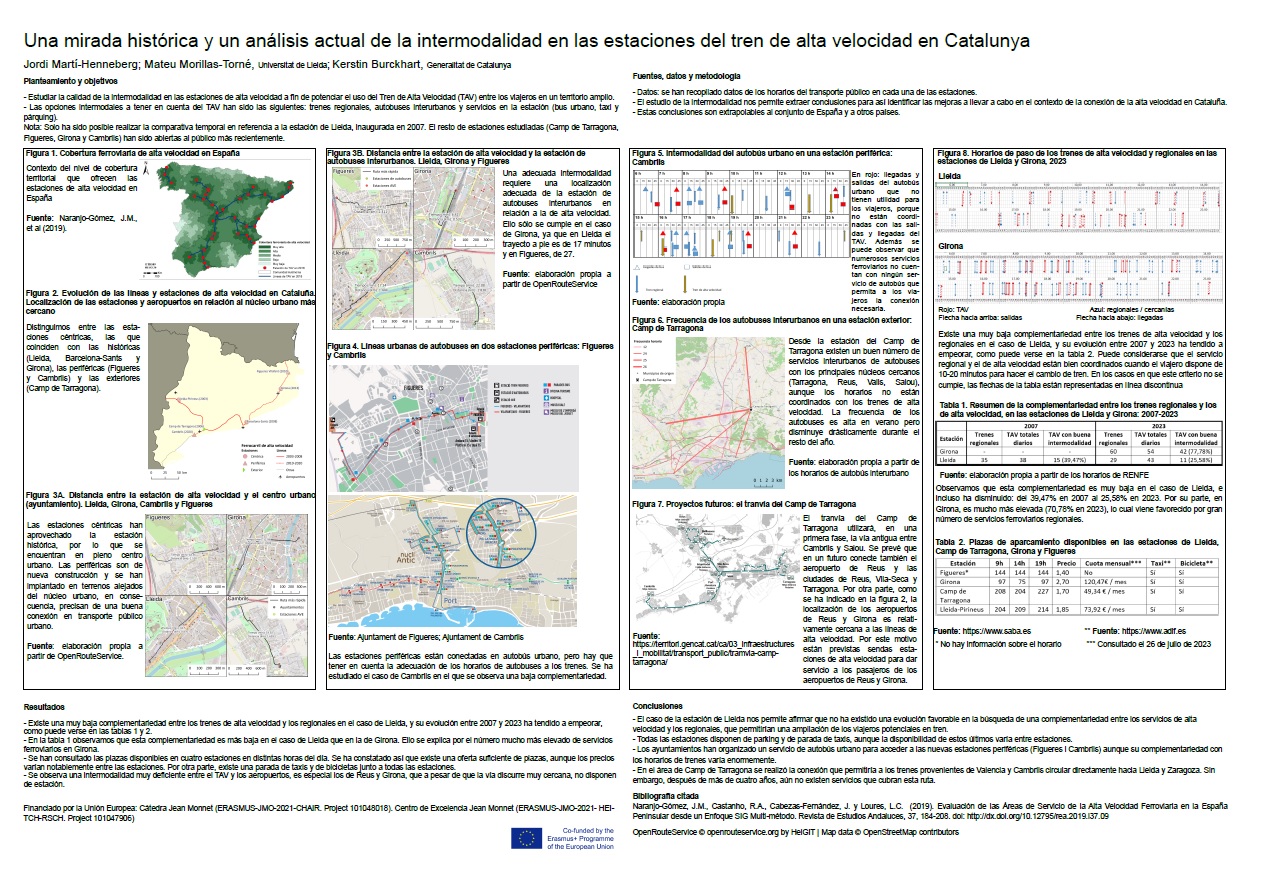
Jordi Martí Henneberg (University of Lleida), Mateu Morillas Torné (University of Lleida), Kerstin Burckhart (Government of Catalonia)
A Historical Perspective and Current Analysis of Intermodality at High-Speed Train Stations in Catalonia
How were high-speed rail stations connected when they opened two decades ago?
How has this intermodality between high-speed rail, conventional rail, and other modes of transportation evolved to the present day?
These are two of the main questions this paper aims to address. Having previously researched the high-speed rail network’s interconnections at the time of its arrival in Catalonia two decades ago, we now wish to compare the initial situation with the current one at four high-speed rail stations: specifically, Figueres, Girona, Camp de Tarragona, and Lleida.
To this end, we propose conducting an analysis of intermodality based on four case studies: the high-speed stations in Figueres, Girona, Camp de Tarragona, and Lleida.
To this end, we will first collect data on the schedules of public transportation serving each of the four stations and present this information in analytical diagrams. In addition, we will also compile data on the past and current options for reaching these stations on foot and by private motorized and non-motorized vehicles. A series of maps will be used to visualize the connections these stations have with their catchment areas.
This review of the evolution of rail interconnections will lead us to identify issues and reflect on improvements and possible future trends in the context of high-speed rail connectivity in Catalonia.
Full Text