
Biographical Dictionary of Iberian Railways
Biographical Dictionary of Iberian Railways
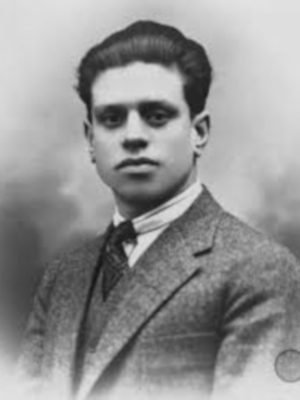
Mário Castelhano
Mário Castelhano (Lisbon, 1896/Tarrafal, 1940),an anarcho-syndicalist activist, railway union organizer, and member of the CGTP; journalist for railway union newspapers and the anarcho-syndicalist newspaper *A Batalha*.
He was born in Lisbon, in the Graça neighborhood, in 1896. At the age of fourteen, he joined the Portuguese Railway Company, where he worked first in the telegraph department and later as a clerk in the Accounting Department.
He participated in the strikes of 1911 and helped organize those of 1918 and 1920. Dismissed after the 1920 strike, he became an employee of the Railway Workers’ Union and the Railway Federation, and eventually a leader of the General Confederation of Labor in the international relations sector. He edited the Railway Federation’s newspapers, *O Ferroviário* and *O Rápido*. He organized the First Railway Congress in 1922.
He was a member of the editorial board of the newspaper *A Batalha*. Following the coup of May 28, 1926, which curtailed civil liberties, he was arrested for the first time in 1927 for his participation in the uprising that same year.
He was arrested and deported to Angola. During his deportation, anarcho-syndicalism faced competition from the emergence of communist-affiliated trade unionism. In 1830, José de Sousa succeeded in establishing a National Federation of Transport and Telecommunications, which attracted unions previously affiliated with the CGTP and the IWA. Railway workers gathered at the Caixa Económica Operária on May 4 of that year and endorsed joining the new Federation. The fact that the leaders of the anarcho-syndicalist railway unions had been deported was decisive in José de Sousa’s success, as he himself came from a background in revolutionary syndicalism. The struggle between the two factions would prove unfavorable to the anarcho-syndicalists. In 1931, Castelhano was in exile in the Azores when the Madeira Revolt broke out; he managed to reach the island in time to participate in it and returned clandestinely to the mainland after the defeat. He remained in hiding, participating in the organization of the movement of January 18, 1834, but was arrested two days before it broke out. Sentenced again to deportation by the special military court, he was initially deported to Terceira Island and, in 1936, transferred to the Tarrafal Concentration Camp in Cape Verde, where he died on October 12, 1940. Bibliography: Projeto, Mosca, University of Évora (testimony of Manuel Henriques Rijo); Aljube Museum, Resistance and Freedom (file PVIDEPT//TT/PIDE/010/N) and Castelhano, Mário, 1975, Four Years of Deportation, Lisbon, Seara Nova, pp. 261.M.F.R. Lopes, 2010, O Sindicalismo Português, na Transição da Ditadura Militar para o Estado Novo, https://Depositorio. UL.pt»ulsd06395_td_m, pp. 395