10th International Congress on Railway History
Alcázar de San Juan, June 24–26, 2026
Great Hall of the Alcázar de San Juan City Hall

The region that today makes up the Autonomous Community of Castilla-La Mancha has witnessed the evolution and development of the railroad throughout Spain since its earliest years. In fact, part of the railway line between Madrid and Aranjuez—the second railway line on the Iberian Peninsula, which will celebrate its 175th anniversary in 2026—ran through the municipality of Seseña in the province of Toledo.
It is, therefore, a region with a rich railway history, which we aim to highlight by hosting this 10th International Congress in the city of Alcázar de San Juan—a town where the railroad has been instrumental to its economic and social development, having served as one of the most important railway hubs on the Iberian Peninsula.
The Iberian Association of Railway History, which counts historical research among its core objectives, has decided to organize the 10thon Railway History, maintaining the international character that has been a hallmark of all previous editions. This 10th Congress dedicates a specific session to the railway in Castilla-La Mancha and proposes a wide range of research topics, with the aim of continuing to expand historical knowledge of the railway.
The 10th International Congress on Railway History is supported by the City Council of Alcázar de San Juan, the city hosting this new edition, which remains firmly committed to the history and future of this mode of transportation, the Spanish Railways Foundation, through its Railway History Program—an institution that has been promoting historical research on railways across all thematic areas and which, since its inception, has played a fundamental role in the planning and organization of previous congresses—and the National University of Distance Education-Ciudad Real. It also benefits from the collaboration of the Regional Government of Castile-La Mancha, the Provincial Council of Ciudad Real, the University of Castile-La Mancha, the University of Alcalá, the International Association of Railway History, the Association of Friends of the Alcázar de San Juan Railway, the Alcázar Cultural Center, and the Gigüela Cultural Association.
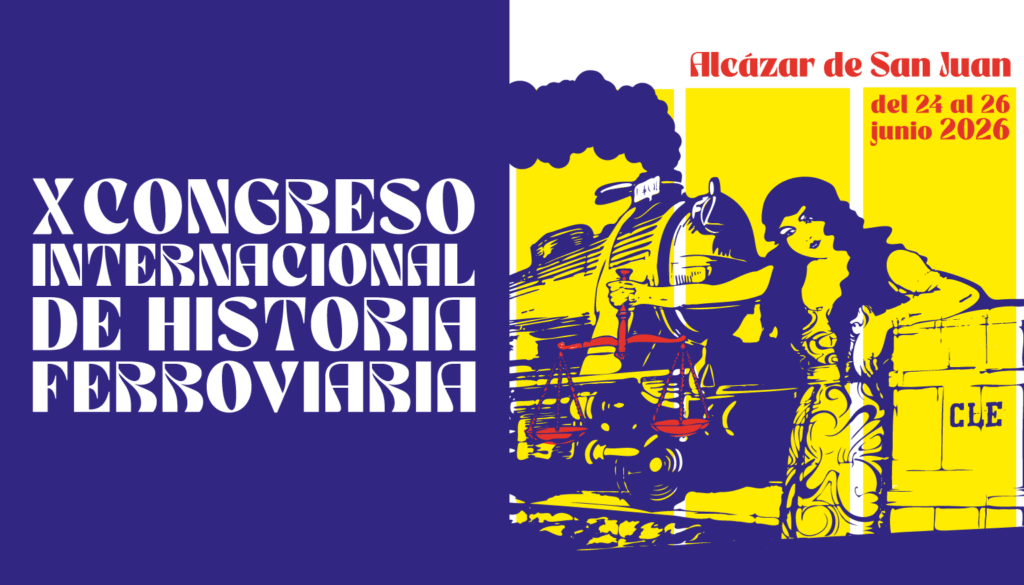
The image used for the poster is an adaptation of the tile mosaic preserved on the façade of the current Official Language School in Alcázar de San Juan, a building that once served as the headquarters of the “La Equidad” Consumer Cooperative, founded in 1906 by local railroad workers employed by the MZA railway company.
The mosaic, the work of Alcázar-born artist Ricardo Illescas López (1909–1998), depicts a scene composed of three elements: a steam locomotive; a female figure in the center holding a scale symbolizing the muse of commerce; and a box bearing the initials of the La Equidad Cooperative, “CLE.”
Sources: Atienza Santiago, Francisco Javier, and Sánchez Coca, Bárbara (2005).Alcázar de San Juan: Cooperativism 1900–1950. (La Equidad, La Alcazareña, La Benéfica, La Confianza, La Esperanza, La Popular, La Unión).Tesela Collection, No. 14. Municipal Cultural Board of Alcázar de San Juan.
https://esculturayarte.com/011477/Mosaico-de-la-Equidad-en-Alcazar-de-San-Juan.html