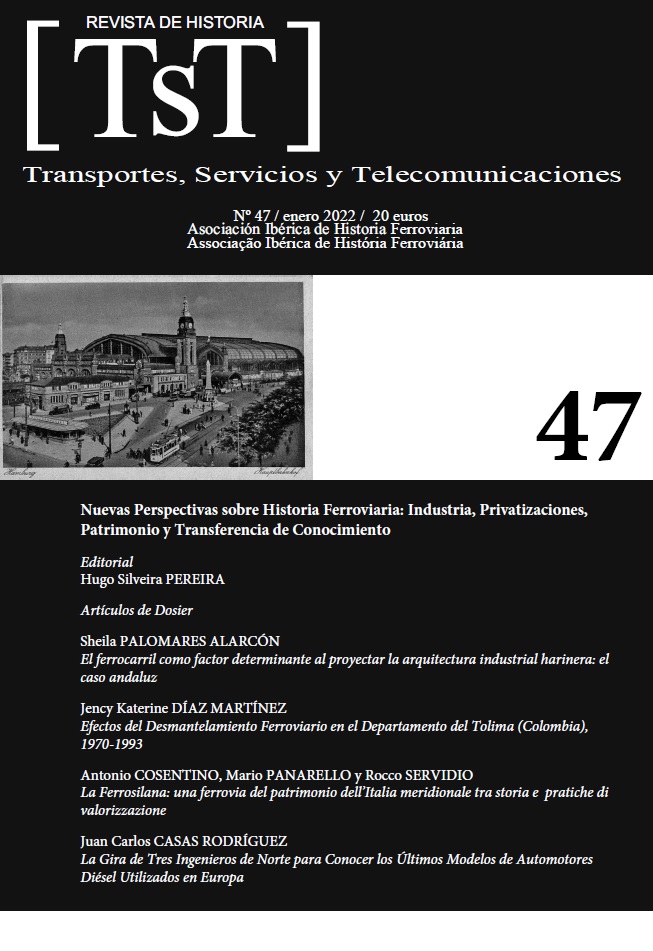
TsT47. 2022.
Articles
♦ Sheila Palomares Alarcón
The Railroad as a Determining Factor in the Design of Industrial Flour-Milling Architecture: The Case of Andalusia
Abstract:
At the dawn of the 20th century, numerous flour mills in Andalusia were built along railroad lines, taking advantage of this mode of transportation to move their goods. However, the railroad’s influence on these industries went beyond mere logistical support; it was a determining factor in the choice of their location—typically near a railroad station—and a decisive element in the design of their architecture. This article aims to examine some significant examples of flour mills built alongside railroad tracks and analyze how their facades facing the train were designed, as if they were storefronts.
♦ Jency Katerine Díaz Martínez
Effects of Railroad Dismantling in the Department of Tolima (Colombia), 1970–1993
Abstract:
This study analyzes the economic, labor, and social consequences resulting from the dismantling of the railroad in the Department of Tolima in Colombia. It begins by examining the regulations governing the liquidation process, the legal framework of the company Ferrocarriles Nacionales de Colombia, and the loss of human capital. The text highlights the situation of railroad workers and, in particular, their reaction to the changes that began between 1989 and 1993. To this end, the study provides a general overview of the railroads’ final phase using a qualitative approach, shedding light on the workers’ experiences during this dismantling process through interviews, reports, and the analysis of periodicals such as newspapers and magazines.
♦ Antonio Cosentino, Mario Panarello, and Rocco Servidio
The Ferrosilana: A Heritage Railway in Southern Italy—Between History and Preservation Practices
Abstract:
This essay aims to trace the main phases of the construction of the Silana Railway, one of the most important heritage railways in Calabria, Italy’s southernmost region, as well as to analyze its tourism potential. The study will highlight the most significant events in the history of this historic railway, drawing on historical sources such as archival documents and photographic material. The goal, once the infrastructure’s important historical past has been considered, is to underscore its undeniable tourism value—which, unfortunately, has not yet been fully exploited—and to analyze best practices for evaluating the heritage of this historic railway line.
♦ Juan Carlos Casas Rodríguez
A tour by three engineers from the North to learn about the latest models of diesel railcars used in Europe
Summary:
Since the 1930s, executives at the Northern Spanish Railway Company (Compañía de los Caminos de Hierro del Norte de España) had sensed that internal-combustion vehicles would eventually become an alternative to steam traction. Consequently, Norte began operating some lines with gasoline- or diesel-powered railcars, though on a limited scale, with only a few units. To better understand the characteristics and performance of the diesel railcars operating on some European railways, three executives from Norte undertook a trip through France, Germany, Austria, Hungary, and Italy. This paper details the impressions, interviews, visits, and travels they undertook during the 24 days of this journey in February 1935. Their conclusion was to advise the Board of Directors to proceed with caution before committing to the large-scale acquisition of diesel railcars for long-distance travel.
Reviews of Current Plays
♦ Juan Manuel Matés Barco
Antonio Vázquez Barquero and Juan Carlos Rodríguez Cohard (eds.), Globalization and Territorial Development
♦ Antonio Santamaría García
Guilherme Grandi (ed.), Transportation and Economic Structures in Latin America
♦ Jesús Mirás Araujo
Nuria Rodríguez Martín, Advertising and the Birth of the Consumer Society: Spain, 1900–1936
Reviews of Classics
♦ Inês Gomes
James R. Ryan, *Picturing Empire: Photography and the Visualization of the British Empire*
♦ Renato Pistola
Pedro Lains, The Portuguese Economy in the 19th Century: Economic Growth and Foreign Trade, 1851–1913